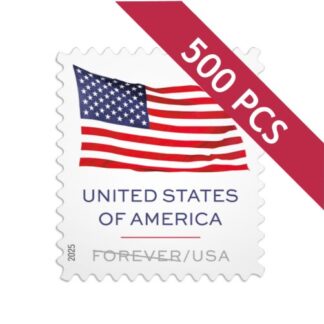
A field-service business mailing 850 pieces a month — invoices, service reminders, seasonal offers — spends about $697 a month on postage at the 2026 Forever stamp rate of $0.82, or $8,364 a year. The cost is not the problem; the lack of a system is. Postage bought in drips at the retail counter, in the wrong quantities, in the wrong weeks, quietly becomes one of the largest unmanaged lines in the office. This guide turns it into a budgeted, seasonal operation.
Key Takeaways
- 850 pieces a month at $0.82 = about $697/month, $8,364/year in postage.
- Seasonal peaks (spring prep, fall overseeding) should be stocked in advance, not bought retail in peak week.
- Standardize on 1-ounce pieces; use $0.65 postcards for short seasonal reminders.
- Under 3,000 pieces a month, roll stamps usually beat a meter lease on all-in cost.
Current Rates for Field-Service Mail
| Mailpiece | 2026 USPS rate | Notes for bulk buyers |
|---|---|---|
| Forever stamp, 1 oz letter | $0.82 | Base unit for all First-Class letter budgeting |
| Each additional ounce | $0.29 | Weigh inserts before ordering; 2 oz letter = $1.11 |
| Postcard | $0.65 | Cheapest First-Class format for short messages |
| Non-machinable stamp (single-use) | $1.31 | $0.82 postage + $0.49 surcharge, sold as one stamp |
| Global Forever stamp, 1 oz | $1.75 | One stamp covers a 1 oz letter to any country |
| Large envelope, 1 oz | $1.69 | Flat-size mail; verify thickness and rigidity |
Two rates matter most for seasonal mailers. The Forever stamp is $0.82, not the pre-July rate quoted in older guides — that gap is $34 a month on 850 pieces. And a 2-ounce service packet with a brochure costs $1.11; if the brochure can be trimmed to keep the piece at 1 ounce, the saving is $0.29 a piece across the whole mailing.

Seasonal Volume Planning
Landscaping and field-service mail follows the season. Build the annual plan around the peaks instead of reacting to them:
| Period | Typical mail | Pieces | Postage at $0.82 |
|---|---|---|---|
| January (planning) | Renewals, contracts | 600 | $492 |
| March (spring prep) | Seasonal offers, reminders | 1,400 | $1,148 |
| June (steady season) | Invoices, notices | 850 | $697 |
| September (fall work) | Overseeding, clean-up offers | 1,300 | $1,066 |
| December (close-out) | Thank-yous, renewals | 700 | $574 |
Order the March and September peaks in January and July respectively, in full rolls. A peak-week retail run costs staff time, risks stock-outs, and breaks the batch routine. A reserve bought ahead also locks in the $0.82 value before any announced increase.
A Five-Step Mailroom SOP for Seasonal Businesses
- Fix the monthly cap. Set a postage budget per month from the seasonal table above, and review it quarterly — not when the drawer is empty.
- Standardize the piece. One envelope size, one insert stack, one weight band. Every piece that creeps to 2 ounces costs an extra $0.29.
- Batch by week. Mail once or twice a week in counted trays of 50 instead of daily drips. Batching cuts handling time and makes counts auditable.
- Use postcards for reminders. A seasonal reminder that fits on a postcard costs $0.65 instead of $0.82 — a $0.17 saving per piece, $170 on a 1,000-piece drop.
- Count quarterly. Count stamp stock at each quarter-end and reconcile against the log. Unexplained shrinkage is usually a process gap, not theft.

Where the Money Actually Goes
| Cost | Monthly, 850 pieces | Notes |
|---|---|---|
| Postage, Forever stamps | $697.00 | At $0.82; the dominant line |
| Envelopes and printing | $180.00 | Standardize to cut waste |
| Handling labor | $150.00 | Batching cuts this fastest |
| Retail trips / rush orders | $0–$80 | Eliminated by advance ordering |
| All-in monthly | ~$1,027 | Postage is 68% of the total |
The lever is not haggling over the stamp — the rate is the rate. The lever is weight discipline, batching, and advance ordering. Those three habits are worth more than any discount claim.
Frequently Asked Questions
How much does a landscaping business spend on postage?
A field-service business mailing 850 pieces a month spends about $697 a month on Forever stamps at $0.82, or $8,364 a year. Seasonal marketing pushes the total higher in spring and fall.
What is the cheapest way for a seasonal business to handle postage?
Buy Forever stamps in bulk before the seasonal peak, standardize on 1-ounce pieces, and use postcards at $0.65 for short seasonal reminders. Avoid rush orders and retail counter trips during peak weeks.
Should a landscaping company use a postage meter?
For most field-service mailrooms under 3,000 pieces a month, physical stamps in rolls are cheaper all-in than a meter lease once lease, ink, and maintenance are counted. See our meter comparison guide for the full math.
How do I stop postage from piling up as overhead?
Treat postage as a budgeted line with a monthly cap, a fixed order quantity, and a quarterly count. Seasonal spikes should be planned in January, not discovered in March.
Do Forever stamps expire if I buy them in bulk?
No. Forever stamps remain valid for a 1-ounce First-Class letter regardless of later price changes, which is why a seasonal reserve bought before a peak is safe to hold.
Sources
- USPS Notice 123, Price List (effective July 12, 2026) — First-Class Mail rates including the $0.82 Forever stamp, $0.29 additional ounce, and $1.75 Global Forever stamp.
- USPS Postal Store — Non-Machinable stamp listing at $1.31 ($0.82 postage plus $0.49 non-machinable surcharge).
We supply field-service businesses with bulk Forever stamp rolls, inspected and shipped tracked, so seasonal peaks never catch the mailroom short. Browse our bulk stamp selection or read more business mailing tips to plan your next order.

Former USPS clerk with 25 years of service, now retired in Florida. She writes about Forever Stamps for the website, offering reliable insights on postal changes, discount opportunities, and practical mailing solutions for households.