A law firm with 500 active clients mails more letters in a month than most businesses mail in a quarter: engagement letters, fee agreements, invoices, case updates, court date reminders, and settlement notices. Each one is a standard 1 oz First-Class letter, so a 500-piece client mailing costs $410 in postage with one Forever stamp per piece. The firms that run this well treat client mail as a system — a list, a template, a weight, and a standing stamp order — not as a daily scramble to the Post Office.
Key Takeaways
- A law firm’s routine client mail is engagement letters, invoices, case updates, court date reminders, and settlement notices — all standard 1 oz First-Class letters at $0.82 each.
- A 500-piece client mailing costs $410 at $0.82 a letter. A 1,000-piece mailing costs $820, and a 2,000-piece mailing costs $1,640.
- Mail court date reminders 2 to 3 weeks before the date, so the client has time to arrange time off work and travel. First-Class Mail carries a 1 to 5 day service standard.
- Keep client mail in sealed letters, not postcards. A postcard at $0.65 shows the client’s name and the matter to everyone who handles it.
- Mailed notice is not a substitute for formal service of process where a court or statute requires personal service. Check the court’s rules before choosing the mailing method for any filing or deadline notice.
What Law Firms Mail, and When
Five kinds of mail make up almost all of a firm’s client correspondence. Each one has its own trigger and its own timing, and each one goes out as a letter, because client mail carries names, dates, and amounts that do not belong on a postcard.
| Notice type | Trigger | Mail when | Format |
|---|---|---|---|
| Engagement letter and fee agreement | New client signs on | Same day as intake | Letter, often 2 oz with enclosures |
| Invoice or billing statement | Monthly billing cycle | First week of the month | Letter, 1 oz |
| Case status update | Filing, ruling, or settlement step | Within 2 business days | Letter, 1 oz |
| Court date or hearing reminder | Hearing scheduled | 2 to 3 weeks before the date | Letter, 1 oz |
| Settlement or closing notice | Case closes | Within 1 week of closing | Letter, 1 oz to 2 oz |
The court date reminder is the mailing that matters most. A client who misses a hearing because the reminder arrived late costs the firm far more than the $0.82 stamp. Mail the reminder 2 to 3 weeks before the date, and mail a second reminder 3 days before the hearing for clients who have missed a date before. Two letters at $1.64 total are cheap insurance against a missed appearance.

Postage Math: What 500 Client Letters Cost
Volume is the whole calculation. Count the active clients, multiply by the mailings per client per month, and the stamp order writes itself. A firm with 500 clients that mails each client twice a month sends 1,000 letters a month.
| Monthly volume | Letter, 1 oz ($0.82) | Letter, 2 oz ($1.11) | Annual postage at 1 oz |
|---|---|---|---|
| 250 letters | $205.00 | $277.50 | $2,460.00 |
| 500 letters | $410.00 | $555.00 | $4,920.00 |
| 1,000 letters | $820.00 | $1,110.00 | $9,840.00 |
| 2,000 letters | $1,640.00 | $2,220.00 | $19,680.00 |
Weight is the variable to watch. An engagement letter with a fee agreement and a return envelope often weighs 2 oz, which costs $1.11 instead of $0.82. That is $0.29 a piece, or $290 on a 1,000-piece mailing. Weigh one finished envelope for each notice type, write the weight on the template, and budget from the weighed number, not from a guess. Keep every envelope rectangular: a square envelope triggers the $0.49 non-machinable surcharge, so a square 1 oz notice mails at $1.31, not $0.82.
The Mailing SOP: From Case File to Post Office
Client mail fails in the same three places every time: the wrong address, the wrong enclosure, and the missing stamp. A short SOP fixes all three.
- Pull the mailing list from the case system, not from memory. The list is the client roster as of the billing date, with current addresses. Check for address changes at intake and at every client contact, and update the record the same day.
- Match the enclosure to the template. Each notice type has a fixed enclosure list, printed on the template itself: engagement letter plus fee agreement, invoice plus payment envelope, reminder plus directions to the courthouse. Nothing extra goes in, and nothing is left out.
- Weigh one finished piece per notice type. A 1 oz piece takes one Forever stamp. A 2 oz piece takes $1.11 in postage. A piece over 3.5 oz is no longer a letter. Postage is set by the weighed piece, not by the template.
- Batch by notice type, not by client. All invoices go out together, all hearing reminders go out together. Batching keeps the count clean and the Post Office trip to one run a day.
- Keep a mailing log. Date, client, notice type, and pieces mailed. When a client says a letter never arrived, the log is the answer, and when the firm needs a mailing receipt, ask the Post Office about a certificate of mailing for the pieces that need one.
- Carry the mail to the Post Office. A batch of client letters dropped in a street collection box can sit until the next pickup. Hand the batch over the counter and get a receipt, especially for anything tied to a court date.

Ordering Stamps for a Law Office
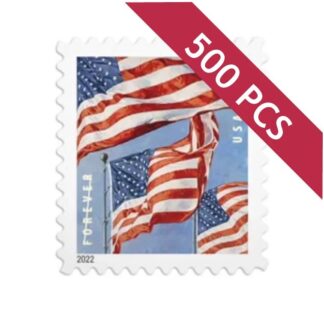
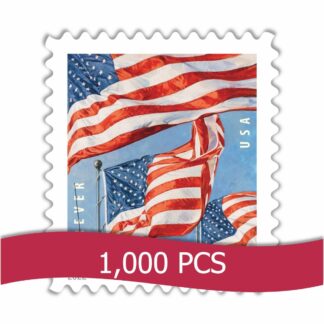
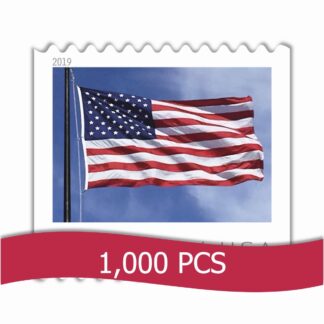
A firm that mails 1,000 letters a month uses 12,000 stamps a year, which is $9,840 in postage at $0.82 a letter. We carry Forever stamps in bulk packs of 100, 500, and 1,000 pieces, so a 1,000-letter month is one 1,000-piece pack, and a year’s supply is twelve of them. Order from the bulk and wholesale stamp packs at the start of the month, before the billing cycle, not after it. Forever stamps never expire, so stock bought this month is still good after any future price increase, and a drawer of stamps is the difference between mailing the invoices on the first and mailing them on the fifth. Set a reorder rule while you are at it: when the stamp drawer holds less than one month’s worth, place the next order. That single rule is what keeps a law office from discovering it is out of stamps on billing day.
Client Mail Is Client Service
Clients judge a firm by how it communicates, and a letter that arrives on time, with the right enclosure and the right date, is the firm’s reputation in an envelope. The mailing system does not need to be complicated: a current list, a weighed envelope, a batch a day, and stamps bought before they are needed. Build that, and the mail takes care of itself. See the bulk Forever stamp packs and match the order to your monthly client volume.
Frequently Asked Questions
How much does it cost a law firm to mail 500 client letters?
A standard 1 oz letter costs $0.82 with one Forever stamp, so 500 letters cost $410. If the letter plus enclosures weighs 2 oz, the cost is $1.11 a piece, or $555 for 500.
When should a law firm mail a court date reminder?
Mail 2 to 3 weeks before the hearing date, so the client has time to arrange time off work and travel. First-Class Mail carries a 1 to 5 day service standard. For clients who have missed a date before, mail a second reminder 3 days ahead.
Can a law firm use Forever stamps for client notices?
Yes. A Forever stamp covers a standard 1 oz First-Class letter at the current $0.82 rate, and Forever stamps never expire, so bulk stock bought this month is still valid after any future price increase.
Should client mail go on postcards to save postage?
No. A postcard costs $0.65, but it shows the client’s name and the matter to everyone who handles it. Client notices, invoices, and hearing reminders belong in sealed letters.
Does mailing a notice count as formal service of process?
Not necessarily. Mailed notice is not a substitute for formal service of process where a court or statute requires personal service. Check the court’s rules before choosing the mailing method for any filing or deadline notice.
Sources
- USPS Notice 123, Price List — current First-Class Mail rates: $0.82 for a 1 oz letter, $1.11 for 2 oz, $0.65 for a postcard, $0.29 per additional ounce, and the $0.49 non-machinable surcharge.
- USPS, First-Class Mail — 1 to 5 day service standard for First-Class Mail.

Former USPS employee with 5 years of service and 25 years in corporate mailing management. Certified in Mail Systems Management and trained at the USPS Business Mail Academy, Kobe now shares trusted guidance on U.S. postage stamps and safe buying practices after retiring in 2023.