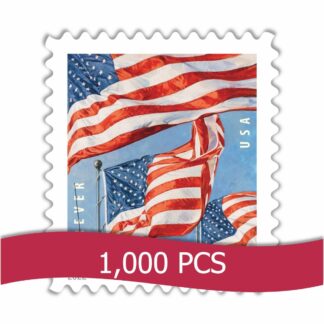
A veterinary clinic with 3,200 registered pet patients can run its whole reminder program on 6,400 postcards a year — two rounds, one for vaccine due dates and one for annual exams — at $4,160 a year in postage at the current $0.65 postcard rate. New-client welcome letters add a small letter stream on top, about 480 letters a year. The rest of this guide works out the volume, picks the format, and sets a reorder routine the front desk can run without thinking about stamps again.
Key Takeaways
- Two reminder rounds × 3,200 patients = 6,400 postcards a year, costing $4,160 in postage at $0.65 each.
- Send postcards for short reminders and letters for welcome packets and anything longer than a few lines.
- Keep a three-month supply on hand — about 1,600 postcard stamps — and reorder when the count falls to 800.
- Metered mail, at the $0.78 metered/PC Postage rate for a 1 oz letter, only touches the small letter stream, and the saving is about $19 a year before meter costs — stamps win at this volume.
Why clinics still mail reminders
A reminder only works if the owner sees it, and a postcard has one advantage email does not: it lands on the kitchen counter, not in a crowded inbox. Vaccine dates and annual exams are the two appointments a clinic cannot afford to let slide, because a missed vaccine can mean a lapsed record and a rescheduled visit, and a missed exam can mean a problem found months later than it should have been. Mail reaches every household on the patient list, including owners who never open the clinic’s emails and owners who never gave a mobile number.
Timing matters as much as the channel. Mail each round three to four weeks before the due dates it covers, so owners have time to call, pick a day, and arrange transport. First-Class Mail typically arrives in one to five business days, which leaves a comfortable margin and keeps the phones from spiking in a single week.
What goes in the envelope
A clinic really runs two mail streams, and they behave differently. The reminder stream is short and repeatable: the pet’s name, the service that is due, and the phone number to book. The welcome stream is longer and happens once per client: office hours, how to reach the clinic after hours, and what to bring to a first visit. Keeping the two streams separate is what makes the ordering math simple, because each one has its own format, its own rate, and its own reorder point.
For the welcome letters, use a standard one-ounce letter with a Forever stamp at $0.82. A welcome packet that runs to several pages can push a letter over one ounce, and a two-ounce letter costs $1.11, so weigh one finished packet before ordering the stamps for it. Postcards carry no envelope at all, which is part of why they are cheaper to produce as well as cheaper to mail. When the front desk stocks up, the shop carries postcard stamps in 100-piece packs, which keeps the count in whole packs and the reorder arithmetic in round numbers.
Working out the annual volume
Example — stated assumptions: a single-location clinic with 3,200 registered pet patients; two reminder rounds a year (vaccine due dates and annual exams); every patient receives one postcard per round; 40 new clients a month receive a one-ounce welcome letter. No other mail is counted here.
| Mailing | Pieces per year | Format | Postage each | Annual postage |
|---|---|---|---|---|
| Vaccine reminders | 3,200 | Postcard | $0.65 | $2,080.00 |
| Annual exam reminders | 3,200 | Postcard | $0.65 | $2,080.00 |
| Welcome letters | 480 | Letter, 1 oz | $0.82 | $393.60 |
| Total | 6,880 | — | — | $4,553.60 |
The headline number is the postcard line: 6,400 postcards at $0.65 is $4,160 a year, and the welcome letters add $393.60. That is the whole postage budget for the program, before paper and printing, and it is small enough that the clinic should judge the program on kept appointments rather than on postage saved.
Should the letters go through a meter instead? Run the numbers on the letter stream only, because postcards are not part of that comparison. At the $0.78 metered/PC Postage rate for a 1 oz letter, 480 welcome letters cost $374.40 a year against $393.60 with Forever stamps — a saving of $19.20 a year, before meter rental, supplies, and the trip to reset the meter. At this volume the meter does not pay for itself, and stamps keep the welcome letters mailable from the front desk with no equipment. A clinic mailing thousands of letters a month would reach a different answer; a clinic mailing forty a month does not.
Budget one extra 100-piece pack of postcard stamps for the year to cover re-sends after address corrections and the handful of reminders that come back undeliverable. When a postcard is returned, update the patient record before the next round instead of mailing the same address twice.
Postcard or letter: choosing the format
The rule is simple: if the message fits on a card and carries nothing private, send a postcard; if it needs more than a few lines or anything personal, send a letter. A vaccine reminder fits on a card. A welcome packet, an account statement, or a note about a pet’s medical record belongs in an envelope.
| Format | Best for | Postage | Watch out |
|---|---|---|---|
| Postcard | Vaccine and exam reminders | $0.65 | Keep it short; no private details |
| Letter, 1 oz | Welcome packets, first-visit notes | $0.82 | Weigh multi-page packets; 2 oz is $1.11 |
| Square or rigid card | Invitations, keepsake cards | $1.31 non-machinable stamp ($0.82 + $0.49 surcharge) | Only for non-machinable shapes; standard cards do not need it |
A clinic that mails every week usually settles on one standing order of bulk Forever stamps for a busy practice, sized to a quarter’s volume, rather than re-deciding the order every month. That single habit is what keeps the front desk from discovering an empty drawer the week a reminder round is due.
A reorder routine the front desk can run
Stock is a numbers problem, not a guessing problem. Quarterly use is 1,600 postcard stamps and 120 letter stamps, so set the par level — the quantity to hold — at one quarter’s use, and the reorder point at half of that, about six weeks of cover. When the count hits the reorder point, order the next quarter’s supply the same day.
Run a monthly count on the first Monday of the month. Count postcard stamps and letter stamps separately, write both numbers on a single count sheet, and compare them with the par levels below. If either number is at or below its reorder point, place the order that day; do not wait for the next count.
| Stamp | Quarterly use | Par level | Reorder point | Order size |
|---|---|---|---|---|
| Postcard ($0.65) | 1,600 | 1,600 | 800 | 16 × 100-piece packs |
| Forever letter ($0.82) | 120 | 200 | 100 | 2 × 100-piece packs |
Store stamps in a cool, dry drawer away from sunlight, and keep coils or sheets flat so the perforations do not snag. Check a few stamps from each new pack before the batch goes out: the design should be whole, the perforations clean, and the gum dry. A clinic that counts monthly, orders at the reorder point, and keeps one quarter on hand will not miss a reminder round for want of a stamp. Restock from the shop in 100-piece packs so the count stays in whole packs and the next count takes a minute.
Frequently asked questions
How many postcard stamps does a 3,200-patient clinic use in a year?
6,400 postcards: two rounds of 3,200, one for vaccine due dates and one for annual exams. At the $0.65 postcard rate that is $4,160 a year in postage, plus 480 welcome letters at $0.82 each.
Should vaccine reminders go as postcards or letters?
Postcards, as long as the message is short and carries nothing private. A postcard costs $0.65 against $0.82 for a one-ounce letter, needs no envelope, and is readable the moment the owner picks up the mail. Use letters for welcome packets and anything with personal or medical detail.
Can a clinic use metered mail instead of stamps?
Yes, but at this volume it does not save money. The $0.78 metered/PC Postage rate for a 1 oz letter would cut the 480 welcome letters from $393.60 to $374.40 a year — $19.20 saved, before meter rental and supplies. Postcards are not part of that comparison, and stamps need no equipment.
How far ahead should reminders be mailed?
Three to four weeks before the due dates they cover. First-Class Mail typically arrives in one to five business days, which leaves owners time to call and book without the phones spiking in a single week.
What should the clinic do with reminders that come back undeliverable?
Update the patient record first, then re-send only if the corrected address is confirmed. Do not mail the same address twice, and keep one spare 100-piece pack of postcard stamps in the year’s budget for re-sends and address corrections.
Sources

Former USPS employee with 5 years of service and 25 years in corporate mailing management. Certified in Mail Systems Management and trained at the USPS Business Mail Academy, Kobe now shares trusted guidance on U.S. postage stamps and safe buying practices after retiring in 2023.