Every month, the front desk of a 3,600-patient dental practice pulls the recall list, prints 600 postcards, and mails them three weeks before the due dates. That one routine, plus a welcome letter for each of the 90 new patients who arrive monthly, is the whole mailing program. It runs on two stamp stocks and costs $5,565.60 a year in postage.
Key Takeaways
- A 3,600-patient practice on a six-month recall cycle mails 600 recall postcards a month, or 7,200 a year. At the $0.65 postcard rate, that stream costs $4,680.00 a year.
- Mailing recall as postcards instead of 1 oz letters saves $1,224.00 a year: 7,200 postcards at $0.65 cost $4,680.00, while the same count as letters at $0.82 would cost $5,904.00.
- New-patient welcome letters are the second stream: 90 a month, 1,080 a year, at $0.82 each, or $885.60 a year. Keep them as letters; they carry forms a postcard cannot.
- Postcards are readable by anyone who handles them, so a recall card carries the patient’s first name and the due month only. Anything clinical goes in a sealed letter or on the phone.
- Order in 100-piece packs with a 5% buffer: 76 postcard packs and 12 Forever packs cover the year, at $5,924.00 face value. Reorder when either stock falls to one month’s supply.
Two Mail Streams, One Front Desk
A dental practice’s mail is really two mailings that share a front desk and a stamp drawer. The recall stream runs on the patient list: everyone due for a cleaning in the next month gets a card. The welcome stream runs on new patients: everyone who had a first visit this month gets a letter. Counting the two streams separately is what keeps the stamp order honest, because the recall count is the one that never changes much, and the welcome count is the one that moves with how fast the practice is growing.
| Stream | Format | Postage each | Pieces / month | Pieces / year |
|---|---|---|---|---|
| Recall reminders | Postcard, 4×6 in | $0.65 | 600 | 7,200 |
| New-patient welcome | Letter, 1 oz | $0.82 | 90 | 1,080 |
| Total | — | — | 690 | 8,280 |
The recall number comes straight from the practice software. Divide active patients by six and you have the monthly cohort: 3,600 ÷ 6 = 600. That division is the only piece of arithmetic the front desk needs, and it is exact enough to order stamps by. The welcome number comes from the new-patient log, not from a guess: count first visits last month and you have next month’s welcome count within a few letters.
Timing is the part most practices get wrong. Recall postcards go out three to four weeks before the due date, which is the window dental consultants recommend — early enough for the patient to reschedule, late enough that the card is still on the fridge when the week arrives. A card mailed the week of the appointment is a card that arrives after the patient already forgot.
Worked Example: A 3,600-Patient Practice, Counted to the Stamp
Example — assumptions: a two-doctor practice with 3,600 active patients on a six-month hygiene cycle and 90 new patients a month. Every recall goes as a 4×6 in postcard at $0.65. Every welcome letter is a standard 1 oz letter at $0.82. The practice adds a 5% buffer for misprints, bad addresses, and reprints. Rates are the USPS rates effective July 12, 2026, checked November 15, 2026.
| Line | Calculation | Result |
|---|---|---|
| Recall postcards | 7,200 × $0.65 | $4,680.00 |
| Welcome letters | 1,080 × $0.82 | $885.60 |
| Annual postage | $4,680.00 + $885.60 | $5,565.60 |
| Recall as letters, for comparison | 7,200 × $0.82 | $5,904.00 |
| Saving from the postcard switch | $5,904.00 − $4,680.00 | $1,224.00 |
| Postcard stamps to order (5% buffer) | 7,560 stamps, 76 packs of 100 | $4,940.00 face value |
| Forever stamps to order (5% buffer) | 1,134 stamps, 12 packs of 100 | $984.00 face value |
| Total face value of the order | $4,940.00 + $984.00 | $5,924.00 |
The $1,224.00 saving is the whole argument for the switch. It is not a discount or a promotion; it is the $0.17 gap between a postcard and a letter, multiplied 7,200 times. A practice that mails recall as letters pays that gap every month without noticing, because $0.17 looks like nothing on a single piece.
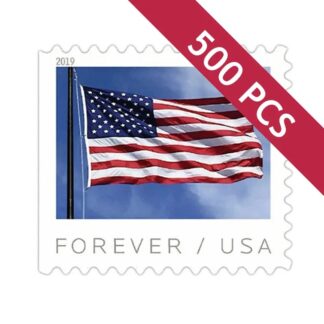
Our shop lists the Coral Reefs postcard 100-piece packs at $59.00 against a $65.00 face value, and the Dahlias Forever 100-piece packs at $69.00 against an $82.00 face value, both verified November 15, 2026. At those prices the 76 postcard packs cost $4,484.00 and the 12 Forever packs cost $828.00, or $5,312.00 for the year’s stamps. The buffer packs stay sealed and labeled by year; postcard stamps and Forever stamps never expire, so leftover stock opens next year’s recall cycle.

Postcard or Letter: The Format Call
The format decision is a question about what the piece has to carry, not about price. A postcard has no envelope to open, so the message reads in the seconds between the mailbox and the kitchen counter. USPS’s 2025 Household Mail Survey found households read 51% of the advertising mail they receive, and a postcard skips the open-it step entirely. That is why it wins for recall: one line, one date, one phone number.
| Format | Postage | Best for | Watch out |
|---|---|---|---|
| Postcard, 4×6 in | $0.65 | Recall reminders, one-line message | Readable by anyone handling it: first name and due month only, no treatment detail |
| Letter, 1 oz | $0.82 | Welcome packets, forms, instructions | Costs $0.17 more per piece than a postcard; weigh the packet before ordering |
| Letter, 2 oz | $1.11 | Full welcome packet with forms and policies | The 2 oz tier is where budgets leak; a packet that tips past 1 oz needs $0.29 more |
The verdict is simple. Postcards for recall, letters for welcome packets. A welcome letter carries forms, office policies, and a map, and that packet is the one mailing where a 2 oz letter at $1.11 is normal. A recall card carries a name and a month, and paying letter postage for that is paying $0.17 to hide a sentence nobody needed hidden. Practices that run the postcard switch usually end up ordering dental reminder postcards in bulk for the whole year instead of buying small packs each month when the recall week arrives.
The Par-Level Reorder Routine
A recall week must never wait on a supply run. The routine below fits on one page taped inside the stamp drawer, and it runs the same way every month.
- Set the par levels: hold 12 postcard packs (1,200 stamps, about two months of recall) and 2 Forever packs (200 stamps, about two months of welcome letters). That is the standing stock.
- Set the reorder points: order more postcard packs when the count falls to 6 packs (600 stamps, one month of recall) and more Forever packs when it falls to 1 pack (100 stamps, about one month of welcome letters).
- Count on the first Tuesday: the same day the recall list is pulled, count both stocks and write the numbers on the drawer sheet. Two minutes, once a month, and the practice never discovers an empty drawer on a mailing day.
- Inspect every delivery on arrival: count the packs against the packing slip, open one pack in ten and check the print and perforations, and log the delivery date on the drawer sheet. A short count now beats a short recall run later.
- Store flat, away from heat: keep packs flat in the drawer, out of direct sun and away from the sterilizer room. Heat and humidity curl postcard stock and gum the adhesive.
The receiving check is the step most offices skip, and it is the cheapest insurance in the whole routine. A pack that arrives short or misprinted is a problem you catch in thirty seconds at the front desk; the same pack discovered empty on recall day is a week of missed cleanings. We inspect every roll and pack before it ships, and the shop carries the 100-piece postcard and Forever packs this routine is built around.

Frequently Asked Questions
How many recall postcards does a dental practice mail in a year?
Divide active patients by the recall interval in months. A 3,600-patient practice on a six-month cycle mails 600 postcards a month, or 7,200 a year. Run the same division on your own active-patient count and you will know your annual volume within a few dozen cards.
Is a postcard cheaper than a letter for dental reminders?
Yes. A postcard mails for $0.65 and a standard 1 oz letter mails for $0.82 with one Forever stamp, so each recall card saves $0.17. On 7,200 cards a year, that is $1,224.00.
What should a recall postcard say?
Keep it to the patient’s first name, the due month, and the phone number or booking link. A postcard can be read by anyone who handles it, so treatment details, balances, and anything clinical belong in a sealed letter or on the phone.
When should recall postcards go out?
Three to four weeks before the due date. That window gives the patient time to reschedule and gives the front desk time to fill any opening the replies leave behind.
How many stamps should a practice keep on hand?
Hold about two months of each stock: 12 postcard packs and 2 Forever packs for the 3,600-patient example. Reorder when either stock falls to one month’s supply, and count both stocks on the same day the recall list is pulled each month.
Sources
- USPS — Business Prices (First-Class Mail rates effective July 12, 2026: 1 oz $0.82, additional ounce $0.29, postcard $0.65; checked November 15, 2026)
- USPS — First-Class Mail (delivery and service information)
- Dentistry IQ — Recall, the Heartbeat of the Dental Practice (recall postcards mailed three to four weeks ahead of appointments)
Recall is the cheapest hygiene chair a practice owns, and the postcard is the cheapest way to fill it. Count the two streams, order both stocks once with a buffer, and tape the par levels inside the drawer. If your practice’s recall count is already taking shape, see the 100-piece postcard and Forever packs in our shop and place one order that covers the whole year.

Former USPS employee with 5 years of service and 25 years in corporate mailing management. Certified in Mail Systems Management and trained at the USPS Business Mail Academy, Kobe now shares trusted guidance on U.S. postage stamps and safe buying practices after retiring in 2023.