Every W-2 and 1099-NEC a CPA firm prepares has to reach its recipient by January 31. For a firm that prepares forms for dozens of small employers, that deadline turns into a single January mailing of several thousand envelopes, and the firms that finish on time treat it as a procurement job, not a last-minute errand: count the forms in December, weigh a finished packet, order the stamps before the holidays, and mail in two waves.
Key Takeaways
- The IRS furnishing deadline for W-2s and 1099-NECs is January 31. Mail the last wave by January 26 so First-Class delivery lands in time.
- A firm preparing 3,900 forms needs 41 rolls of 100 Forever stamps (4,100 stamps, $3,362.00 face value) once a 3% buffer is added.
- Weigh a finished packet before ordering. A W-2 with a cover letter and a reply envelope often crosses 1 oz, and a 2 oz packet costs $1.11, not $0.82.
- Order in December and keep the buffer rolls sealed. Forever stamps never expire, so leftover stock opens next tax season.
The January 31 Deadline Sets the Whole Schedule
January 31 is the date the forms must be furnished to recipients, not the date the firm starts printing. Working backward from that date gives a schedule with no slack in it, and the schedule is the same whether the firm prepares 400 forms or 4,000. The printing, the stuffing, and the mailing each need their own day, and the mailing itself needs two waves because client data never all arrives at once.
| Date | Action | Who owns it |
|---|---|---|
| Early December | Count expected forms by client; order stamps | Office manager |
| January 5–15 | Print and stuff forms for clients whose data is final | Tax preparers |
| January 16–20 | Mail wave one; chase missing client data | Mailroom / front desk |
| January 21–23 | Print and stuff the late arrivals | Tax preparers |
| January 24–26 | Mail wave two, the final wave | Mailroom / front desk |
| January 27–31 | Handle reprints, bad addresses, and corrections | Office manager |
The two-wave structure is the part most firms get wrong. Mailing everything in a single late-January push means the stuffing crew works nights, the error rate climbs, and any printer jam on January 28 becomes a missed deadline. Wave one clears the finished majority; wave two is small enough to absorb the stragglers.
Two Form Streams, One Mailing
A CPA firm’s January mailing is really two mailings that share an envelope size and a stamp. The W-2 stream runs on employees: one form per employee of each client business, plus the state copies that ride along in the same envelope. The 1099 stream runs on contractors and vendors: one 1099-NEC per payee, usually with fewer pages but the same weight class. Counting the two streams separately is what keeps the stamp order honest, because the 1099 count is the one firms underestimate — a client with 60 employees often has 25 contractors nobody counted in November.
| Stream | What goes in the envelope | Typical weight | Postage |
|---|---|---|---|
| W-2 | Employee copies, state copies, cover letter | 1 oz, sometimes 2 oz | $0.82 or $1.11 |
| 1099-NEC | Payee copy, cover letter | 1 oz | $0.82 |
| Corrections | Corrected form, short explanation | 1 oz | $0.82 |
The weight column is where the money hides. A W-2 packet with three state copies, a cover letter, and a reply envelope weighs more than a single sheet, and a packet that tips past 1 oz needs a second stamp’s worth of postage: $1.11 instead of $0.82. Weigh one finished packet of each type on a postal scale in December, before ordering, and the stamp count follows from the scale instead of from a guess.
Worked Example: A Firm Mailing 3,900 Forms
Example — assumptions: a mid-size CPA firm prepares W-2s for 45 small-business clients averaging 60 employees each (2,700 W-2s) and 1099-NECs for 1,200 contractors and vendors. Every packet is a standard 1 oz letter. The firm adds a 3% buffer for misprints, bad addresses, and reprints.
| Line | Calculation | Result |
|---|---|---|
| W-2 packets | 2,700 × $0.82 | $2,214.00 |
| 1099-NEC packets | 1,200 × $0.82 | $984.00 |
| Base postage, 3,900 forms | 3,900 × $0.82 | $3,198.00 |
| Buffer at 3% | 117 stamps × $0.82 | $95.94 |
| Total to order | 4,017 stamps, rounded up | 41 rolls of 100 |
| Face value of the order | 4,100 × $0.82 | $3,362.00 |
One variation changes the answer by real money. If 600 of those W-2 packets carry enough state copies to weigh 2 oz, those 600 need $1.11 each instead of $0.82: 600 × $1.11 = $666.00 instead of 600 × $0.82 = $492.00, a $174.00 difference on one batch. That is the whole reason to weigh a sample packet in December. The arithmetic is easy; the expensive mistake is pricing a 2 oz mailing as a 1 oz mailing.
Firms that run this cycle every year usually end up ordering Forever stamps in bulk for the whole tax season in one December order, instead of buying small packs each January when the post office line is longest and the clock is shortest.

Coils or Sheets: What a January Mailroom Actually Uses
The format decision is a question about hands, not about price. A roll of 100 Forever stamps feeds an affixing machine or a fast hand-stuffing line; a sheet or booklet of 20 suits a partner stuffing envelopes at a desk. The postage is identical either way, so the choice follows the crew.
| Format | Count | Best for |
|---|---|---|
| Coil (roll) | 100 per roll | Machine affixing and high-volume stuffing lines |
| Sheet | 20 per sheet | Hand stuffing at desks, small batches |
| Booklet | 20 per booklet | Partners and staff working away from the mailroom |
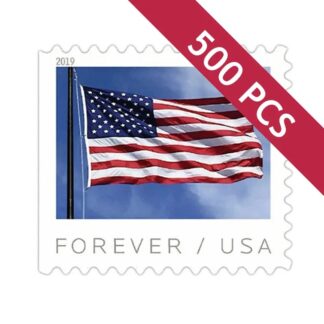
For the 3,900-form example, 41 rolls of 100 cover the mailing with the buffer included, and the rolls stay usable for the rest of the year — quarterly estimates, engagement letters, and client notices all draw from the same stock. Our 100-piece packs are listed at $69.00 against an $82.00 face value, and the shop carries the 100-piece packs and the larger coils a firm needs when the January count runs past a few thousand.
The Reorder Routine: December Order, January Proof
Tax season rewards firms that treat the mailing like a checklist instead of a scramble. The routine below fits on one page and runs the same way every year.
- December count: ask every preparer for an expected W-2 count and an expected 1099 count, in writing, by December 10. Add 3% for reprints.
- Weigh the packet: stuff one finished W-2 packet and one finished 1099 packet, weigh both, and note which one crosses 1 oz.
- Order once: place a single stamp order in December, sized to the counted total plus the buffer. Keep the buffer rolls sealed and labeled by year.
- Two waves: mail finished clients January 16–20 and the late arrivals January 24–26. Never hold a finished batch for a straggler.
- Proof of mailing: keep a mailing log with the date, the count, and the client batch. For any form a client later disputes, the log is the answer.
The log matters more than it looks. A client who says “my employee never got the W-2” in March is answered in thirty seconds from a log, and answered in an afternoon without one.

Frequently Asked Questions
Do W-2s have to be postmarked by January 31?
The IRS requires W-2s and 1099-NECs to be furnished to recipients by January 31. Mailing on January 31 itself cuts it too close — First-Class delivery takes a few days — so we plan the final wave for January 24–26 and keep January 27–31 for reprints and corrections.
How many stamps does a firm need for 1,000 W-2s?
At the current $0.82 Forever rate, 1,000 one-ounce letters need 1,000 stamps, $820.00 in postage. Add a 3% buffer (30 stamps) for misprints and bad addresses, and the order becomes 1,030 stamps — 11 rolls of 100, with 70 stamps left for the next mailing.
What if a W-2 packet weighs 2 oz?
A 2 oz letter costs $1.11: one Forever stamp ($0.82) plus one additional-ounce stamp ($0.29). Weigh a finished packet before ordering so the 2 oz packets are counted separately instead of discovered at the post office.
Can leftover stamps be used next tax season?
Yes. Forever stamps never expire and always cover a 1 oz First-Class letter, whatever the current rate is. Leftover rolls from this January are next January’s opening stock.
Should the firm use metered mail instead of stamps for this?
For a once-a-year surge, stamps are usually simpler: metered mail through a postage meter or PC Postage starts at $0.78 for a 1 oz letter, but that is a meter rate, not a stamp price, and it comes with equipment, supplies, and a lease to manage. A firm that mails heavily all year can run the comparison; a firm whose big mailing is January is better off with rolls.
Sources
- Internal Revenue Service — irs.gov (W-2 and 1099-NEC furnishing deadline, January 31)
- USPS — Business Prices (First-Class Mail rates: 1 oz $0.82, additional ounce $0.29)
- USPS — First-Class Mail (delivery and service information)
Tax season is a procurement problem with a deadline attached, and the firms that treat it that way finish January calm. If your firm’s January count is already taking shape, see the 100-piece packs and larger coils in our shop and place one December order that covers the whole season.

Former USPS employee with 5 years of service and 25 years in corporate mailing management. Certified in Mail Systems Management and trained at the USPS Business Mail Academy, Kobe now shares trusted guidance on U.S. postage stamps and safe buying practices after retiring in 2023.