GivingTuesday 2026 falls on Tuesday, December 1, and December 31 is the last day a gift counts for the 2026 tax year. A nonprofit with 4,000 donors has three mailings between those two dates: two appeal waves in late November, a reminder round in mid-December, and a thank-you run in January. The whole campaign is 8,000 pieces and $6,016.00 in First-Class postage.
Key Takeaways
- GivingTuesday 2026 is Tuesday, December 1. Appeals mailed November 23 to 25 arrive November 25 to 30, before the day, on USPS’s 1-to-5-day First-Class service standard.
- Two appeal waves of 4,000 letters at $0.82 cost $3,280.00. A reminder postcard round to the 3,200 donors not yet heard from costs $2,080.00 at $0.65, and thank-you letters to 800 donors cost $656.00.
- The reply envelope is a budget decision. If it tips the appeal past 1 oz, the piece costs $1.11 instead of $0.82 — $1,160.00 extra across 4,000 appeals. Weigh a finished packet before ordering.
- A business reply envelope costs postage only on the envelopes donors actually return: at a 20% mail-back rate, 800 returns at $0.82 cost $656.00. A courtesy reply envelope costs the nonprofit nothing in postage.
- Thank-you letters are also tax paperwork. The IRS requires a written acknowledgment for any single gift of $250 or more, and for 2026 donors who do not itemize can deduct up to $1,000 in cash gifts ($2,000 for joint filers).
The December Calendar: Three Waves, Two Deadlines
December is where the money is. M+R Benchmarks 2026 found nonprofits received 37% of their 2025 online revenue in December, and December 31 alone brought in 4%. GivingTuesday 2025 drew an estimated $4.0 billion in the U.S. from 38.1 million participants, according to GivingTuesday. The calendar below is built backward from the two dates that matter: December 1, when the giving season opens, and December 31, when it closes for tax purposes.
| Wave | Mail date | Who gets it | Pieces | Postage |
|---|---|---|---|---|
| Wave 1 — appeal | November 23 | Major donors and lapsed donors | 400 | $328.00 |
| Wave 2 — appeal | November 24–25 | The general donor list | 3,600 | $2,952.00 |
| GivingTuesday | December 1 | No mail — the day itself | — | — |
| Wave 3 — reminder postcards | December 14–15 | Donors not yet heard from | 3,200 | $2,080.00 |
| Thank-you run | January 5–9 | Everyone who gave | 800 | $656.00 |
| Campaign total | — | — | 8,000 | $6,016.00 |
Two dates fence the whole plan. USPS’s published guidance recommends mailing First-Class pieces by December 17 for Christmas delivery, so the reminder postcards mailed December 14 to 15 land inside that window. And a gift mailed with a December 31 postmark still counts as a 2026 gift, which is why the last mailed piece should already be in donors’ hands by then — the December 29 to 31 push is email and phone, not paper. Thanksgiving week is a short work week, and the Post Office is closed on Thanksgiving Day, November 26, so nothing gets printed, stuffed, or mailed that day. Plan the work for the weeks before it.
The Reply Envelope Is a Budget Decision, Not a Stationery Choice
Every appeal letter carries a reply envelope, and that envelope is where year-end budgets quietly leak. The choice is not which envelope looks nicer. It is who pays the postage, and whether the envelope pushes the piece over 1 oz.
| Option | What the nonprofit pays | When it wins |
|---|---|---|
| No reply envelope | $0 | Donors give online; but mail-back gifts fall away, and older donors are the ones who still write checks |
| Courtesy reply envelope (donor stamps it) | $0 — the donor pays $0.82 | Cheapest option; keeps the appeal at 1 oz if the packet stays light |
| Business reply envelope | $0.82 only on returned pieces | Highest mail-back response; at a 20% return rate, 800 returns cost $656.00, and the other 3,200 envelopes cost nothing |
The weight question sits underneath all three options. A letter plus a reply card plus a reply envelope often tips past 1 oz, and a 2 oz letter costs $1.11 instead of $0.82. Across 4,000 appeals that is $1,160.00 — more than the entire thank-you run. Stuff one finished packet, weigh it on a postal scale, and count the 2 oz pieces separately before ordering stamps. A packet that weighs 1 oz on the estimate and 2 oz at the post office is the most common year-end surprise there is.

Worked Example: 4,000 Appeals, Three Waves, One Thank-You Run
Example — assumptions: a mid-size nonprofit with a donor file of 4,000 households. Waves 1 and 2 are standard 1 oz appeal letters at $0.82. Wave 3 is a reminder postcard at $0.65 to the 3,200 donors not yet heard from by December 14. The thank-you run is 800 letters at $0.82, assuming a 20% response rate. Rates are the USPS rates effective July 12, 2026, checked November 15, 2026.
| Line | Calculation | Result |
|---|---|---|
| Appeal waves 1 and 2 | 4,000 × $0.82 | $3,280.00 |
| Reminder postcards, wave 3 | 3,200 × $0.65 | $2,080.00 |
| Thank-you letters | 800 × $0.82 | $656.00 |
| Campaign postage total | $3,280.00 + $2,080.00 + $656.00 | $6,016.00 |
| If appeals tip to 2 oz | 4,000 × $0.29 extra | $1,160.00 more |
| Business reply returns (20%) | 800 × $0.82 | $656.00, only if donors mail them back |
| Forever stamps to order (5% buffer) | 5,040 stamps, 51 packs of 100 | $4,182.00 face value |
| Postcard stamps to order (5% buffer) | 3,360 stamps, 34 packs of 100 | $2,210.00 face value |
| Total face value of the order | $4,182.00 + $2,210.00 | $6,392.00 |
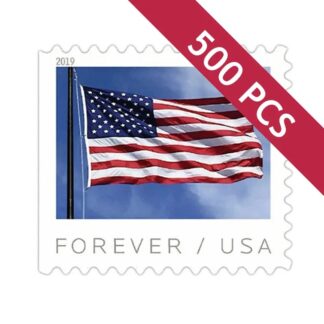
One order covers the whole campaign, including January’s thank-you run, because Forever stamps never expire and the postcard stamps are the same stock the reminder round uses. Our shop lists the Dahlias Forever 100-piece packs at $69.00 against an $82.00 face value and the Coral Reefs postcard 100-piece packs at $59.00 against a $65.00 face value, both verified November 15, 2026. At those prices the 51 Forever packs cost $3,519.00 and the 34 postcard packs cost $2,006.00, or $5,525.00 for the campaign’s stamps. Nonprofits that run this calendar every year usually order their nonprofit year-end fundraising postage in bulk in one November order instead of buying small packs each wave when the post office line is longest.
The Thank-You Run: January’s Mailing Matters as Much as December’s
The appeal gets the gift. The thank-you gets the second gift. Donors thanked within 48 hours give again at far higher rates than donors thanked in February, and the thank-you letter is also the tax document: the IRS requires a written acknowledgment for any single contribution of $250 or more, with the organization’s name, the amount, and a statement about whether any goods or services were provided in return.
Run the thank-you letters January 5 to 9, while the gifts are still fresh. Each letter names the donor, the amount, and one concrete thing the gift made possible. Then invite one-time donors to give monthly within two weeks of their gift; monthly donors are the donors who are still giving next December. For 2026 there is one more line worth putting in the letter: donors who do not itemize can deduct up to $1,000 in cash gifts for the year ($2,000 for joint filers) under the new above-the-line provision. It is a small number, but for a donor deciding whether a $100 gift is worth itemizing, it is the difference between a deduction and none at all.

First-Class or Nonprofit Marketing Mail: The Class Call
Authorized nonprofits have a cheaper lane. USPS’s nonprofit Marketing Mail rate is $0.257 per automation letter at the Mixed tier, against $0.467 commercial, under USPS Notice 123 effective July 12, 2026. Most 501(c)(3) organizations qualify through a one-time USPS application, the minimum is 200 pieces per mailing, and the rate applies to letters up to 3.5 oz. On 4,000 appeal letters that is $1,028.00 against $3,280.00 First-Class — a $2,252.00 gap that no development director can ignore.
The gap buys something, though, and the verdict depends on which mailing carries a deadline. First-Class is forwarded and returned when a donor moves, so every undeliverable piece comes back and the list gets cleaner with each wave. Marketing Mail is slower, its delivery standard is set by the origin and destination ZIP pair, and it does not forward or return the same way. Stamp the deadline waves First-Class; let the nonprofit rate carry only mail with no deadline attached. The two appeal waves and the reminder postcards ride on December 1 and December 17, so they get real stamps. A spring newsletter or a general update with no date on it is the piece that belongs on the nonprofit rate.
Frequently Asked Questions
When is GivingTuesday 2026?
Tuesday, December 1, 2026, the Tuesday after Thanksgiving (November 26). Appeals mailed November 23 to 25 arrive November 25 to 30, before the day.
Does a gift mailed on December 31 count for 2026?
Yes. Gifts made online by midnight on December 31, or mailed with a December 31 postmark, count as 2026 gifts. Your last mailed piece should already be in donors’ hands by then, so the final push is email and phone.
How much does a reply envelope add to the postage bill?
It depends on weight and on who pays. A reply envelope that tips the appeal past 1 oz adds $0.29 per piece, or $1,160.00 across 4,000 appeals. A business reply envelope costs $0.82 only on the envelopes donors return; a courtesy reply envelope costs the nonprofit nothing.
Do donors need a written receipt for their gift?
For any single contribution of $250 or more, the IRS requires a written acknowledgment from the nonprofit. Smaller gifts need the donor’s own records, such as a bank statement. The January thank-you letter doubles as that acknowledgment.
Sources
- USPS — Business Prices (First-Class Mail rates effective July 12, 2026: 1 oz $0.82, additional ounce $0.29, postcard $0.65; checked November 15, 2026)
- USPS — First-Class Mail (1-to-5-day service standard)
- GivingTuesday (GivingTuesday 2026: Tuesday, December 1, 2026)
- IRS — Charitable Contribution Deductions (written acknowledgment required for single contributions of $250 or more)
December rewards the nonprofits that mail on a calendar instead of on a feeling. Three waves, one reply-envelope decision made before printing, and a thank-you run that treats January as part of the campaign, not an afterthought. If your organization’s December list is already taking shape, see the 100-piece Forever and postcard packs in our shop and place one November order that covers the appeal, the reminders, and the thank-you letters.

Former USPS employee with 5 years of service and 25 years in corporate mailing management. Certified in Mail Systems Management and trained at the USPS Business Mail Academy, Kobe now shares trusted guidance on U.S. postage stamps and safe buying practices after retiring in 2023.