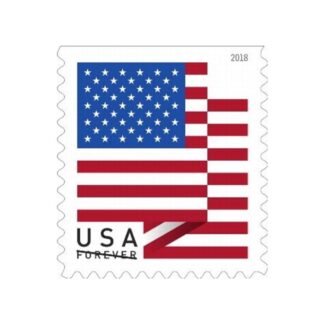
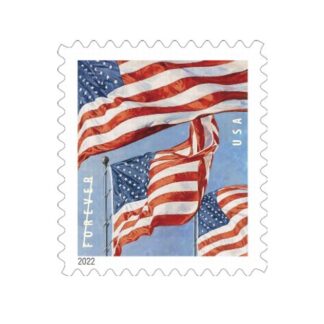
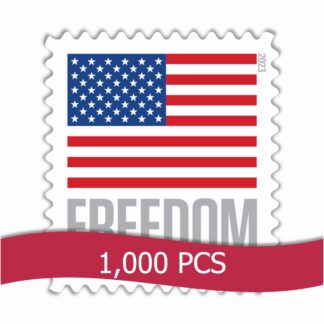
A Forever stamp has no number printed on it — no 55 cents, no 73 cents, no 82 cents. That is not an oversight; it is the product. A Forever stamp is always good for a 1-ounce First-Class letter, whatever the current rate is, which means a stamp bought today at $0.82 still mails a letter after the next rate increase. For a business that buys in bulk, that single fact changes how postage is budgeted, ordered, and held. This guide explains non-denominated postage in plain terms and works the buy-ahead math.
Key Takeaways
- A Forever stamp has no printed denomination: it always covers a 1-ounce First-Class letter, whatever the current rate is.
- The current rate is $0.82 (effective July 12, 2026). A stamp bought at $0.82 stays valid after the next rate increase.
- Non-denominated postage is what makes a planned 3–6 month hold work: buy at today’s rate, mail at tomorrow’s.
- A mailer sending 2,500 pieces a month holds 7,500–15,000 stamps ($6,150.00–$12,300.00 at $0.82) as working cover.
What Non-Denominated Postage Actually Means
Before Forever stamps, every stamp carried a printed denomination, and every rate increase made the stamps in your drawer worth less than a letter. Mailers had to buy small ‘make-up’ stamps to top up old stock to the new rate — an extra purchase, an extra inventory line, and an extra failure mode at the stuffing table. A Forever stamp removes that problem: the stamp’s value is defined as ‘one 1-ounce First-Class letter,’ not as a number of cents, so it tracks the rate automatically.
| Question | Denominated stamp (old model) | Forever stamp |
|---|---|---|
| What is printed on it? | A cent value (e.g. 55¢, 73¢) | No denomination — ‘Forever’ |
| After a rate increase | Worth less than a letter; needs a make-up stamp | Still covers a 1-ounce letter, no top-up needed |
| Inventory | Multiple denominations to track | One product line per format |
| Buying ahead | Risky — a rate change strands the stock | Safe — the stamp tracks the rate |
The practical consequence for a procurement team is inventory simplicity: one stamp, one format, one line on the books. Older denominated stamps are still valid for their face value and can be combined to reach current postage — a 1-ounce letter needs $0.82, a 2-ounce letter $1.11 — but there is no reason to build a bulk stock out of them when the Forever stamp does the same job with no top-up risk.
Current USPS Rates to Budget Against (Effective July 12, 2026)
Every figure in this article uses the current rates below. A Forever stamp costs $0.82 for a 1-ounce letter. The only $0.78 rate in the USPS system is the metered-mail / PC Postage 1-ounce rate — it is not a stamp price, and it is labelled as such wherever it appears.
| Mailpiece | Current rate | Notes |
|---|---|---|
| Forever stamp, 1-ounce letter | $0.82 | Good for 1 ounce, forever, even after future rate changes |
| Each additional ounce | $0.29 | A 2-ounce letter costs $1.11 |
| Postcard | $0.65 | Standard postcard size |
| Non-Machinable stamp (butterfly) | $1.31 | Single-use stamp: $0.82 + $0.49 surcharge |
| Non-machinable surcharge (the fee itself) | $0.49 | Only when discussing the surcharge as a fee |
| Large envelope, 1 ounce | $1.69 | Flat-size mail |
| Global Forever stamp | $1.75 | 1-ounce international letter |
Worked Math: What Buying Ahead Actually Saves
Buying ahead only saves money if the next rate increase arrives before the stock runs out — and USPS has raised First-Class rates repeatedly in recent years. The saving is the difference between today’s rate and the next rate, multiplied by the number of stamps held when the increase takes effect. The size of the next increase is not known in advance, so size the hold from usage, not from a guess about the next announcement.
| Monthly pieces (1 oz) | 3 months of cover | 6 months of cover |
|---|---|---|
| 1,000 | 3,000 stamps — $2,460.00 | 6,000 stamps — $4,920.00 |
| 2,500 | 7,500 stamps — $6,150.00 | 15,000 stamps — $12,300.00 |
| 5,000 | 15,000 stamps — $12,300.00 | 30,000 stamps — $24,600.00 |
Example — the hold in practice (assumptions stated): a lawn-care company mails 2,500 seasonal reminders a month. It holds 7,500 stamps — three months of cover, $6,150.00 at $0.82. If USPS raises the rate while that stock is on the shelf, the company mails the next three months at the old rate with stamps that are already paid for. If no increase comes, nothing is lost: the stamps are still good for the same letters. The hold costs nothing beyond the cash being spent a few months early — and it removes the rate announcement from the mailing schedule entirely.
Formats to price separately: square envelopes need the $1.31 Non-Machinable stamp ($0.82 + $0.49 surcharge); a 2-ounce letter costs $1.11; postcards cost $0.65; international letters need the $1.75 Global Forever stamp.
Buying-Ahead SOP: Hold Without Hoarding
- Measure usage first. Pull three months of actual piece counts by format. The hold is sized from that number, not from a round number in a catalogue.
- Hold 3–6 months of cover. Enough to ride out a rate announcement; not so much that cash sits in a drawer for years.
- Reorder at two weeks of cover. A standing order rhythm beats a panic buy after the drawer is empty.
- Store it properly. Flat, cool, and dry, in original packaging, rotated first-in first-out — see our storage guide for the full SOP.
- Buy from a verified supplier. The hold only works if the stock is genuine: run the price test (near $0.82 passes; far below fails), verify on a small first order, and inspect on arrival.
For the full buying checklist, see our Forever stamp buying checklist, and for storage in detail, how to store bulk stamps for years. We stock bulk Forever stamps in coils, sheets, and booklets with inspection before dispatch and tracked shipping.
Frequently Asked Questions
Why don’t Forever stamps have a face value?
A Forever stamp is defined as covering a 1-ounce First-Class letter, not as a number of cents — so it tracks the rate automatically and stays valid after rate increases. That is the point of non-denominated postage.
How much is a Forever stamp worth in 2026?
A Forever stamp costs $0.82 for a 1-ounce letter, effective July 12, 2026. Postcards cost $0.65, a 2-ounce letter costs $1.11, a Non-Machinable stamp costs $1.31, and a Global Forever stamp costs $1.75.
Do Forever stamps expire?
No. A Forever stamp covers a 1-ounce First-Class letter regardless of when it was bought or later rate changes.
Is buying Forever stamps ahead of a rate increase a good idea?
For a business with steady volume, yes — a 3–6 month hold at $0.82 protects the next mailing from the next rate announcement. Size the hold from measured usage, store it properly, and buy from a verified supplier.
Can I still use old stamps with a printed denomination?
Yes. Older denominated stamps are still valid for their face value and can be combined to reach current postage: a 1-ounce letter needs $0.82, a 2-ounce letter $1.11.
Sources
USPS Notice 123, effective July 12, 2026, for the $0.82 Forever rate, $0.29 additional ounce, $1.11 two-ounce letter, $0.65 postcard, $0.49 non-machinable surcharge, $1.69 large envelope, and $1.75 Global Forever rate. USPS Postal Store (usps.com) for the $1.31 Non-Machinable stamp as a single-use stamp ($0.82 + $0.49).
Buy the stamp that tracks the rate — and hold enough to ride out the next announcement. Browse bulk Forever stamps by format — coils, sheets, and booklets — in our shop, or start with our Forever stamp buying checklist.

Stamp enthusiast and part‑time columnist based in Los Angeles. With a background in office administration and a personal passion for collecting Forever Stamps, she provides readers with practical tips on buying, storing, and using stamps effectively.