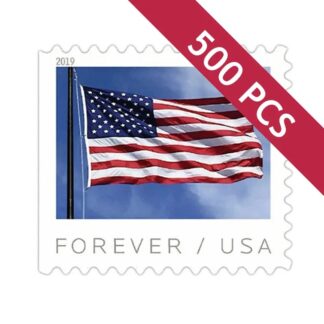
Most Facebook ads selling 100 Forever stamps for $17.99 to $20.99 are not a bargain to evaluate — they fail the first test. One hundred Forever stamps cost $82.00 at face value, so a $19.99 offer is about 76% below face value. No legitimate reseller buys stamps from USPS at a discount anywhere near that deep, which is why the right move is to verify before paying, not to buy first and inspect later.
Key Takeaways
- Face value is the anchor: 100 Forever stamps = $82.00. Any offer at $17.99–$20.99 is 74–78% below face value and should be treated as suspect until proven otherwise.
- The template is recognizable: a nine-image grid, “50% OFF” wording, a countdown timer, comments limited or off, and a page created weeks ago.
- Pay only by a method with a chargeback path. Gift cards, wire transfers, and peer-to-peer payments give you no practical way to recover the money.
- Safe channels are boring on purpose: the USPS Postal Store at face value, a face-value retail counter such as Costco, or an established bulk seller whose prices, address, and reviews you can check.
The Price Test: What 100 Forever Stamps Should Cost
Start every Facebook stamp offer with one multiplication: 100 × $0.82 = $82.00. That is the face value of 100 Forever stamps, and it is the number every other price must be judged against.
| Channel | 100 Forever stamps | Against the $82.00 face value |
|---|---|---|
| USPS Postal Store | $82.00 | Face value |
| Face-value retail counter (for example, Costco) | $82.00 | Face value |
| US Bulk Stamps bulk category (100-piece packs, listed November 10, 2026) | $69.00 | About 16% below face value |
| Typical Facebook ad | $17.99–$20.99 | About 74–78% below face value |
Legitimate bulk sellers can price below face value, but only modestly: they buy in volume, sell in volume, and keep a margin. A 16% discount on a 100-piece pack is the shape a real bulk price takes. A 76% discount is not a volume discount — it is a price at which genuine stamps cannot be profitably sold, which is the point at which counterfeit stock becomes the likelier explanation. One more distinction matters: metered mail through a postage meter or PC Postage starts at $0.78 for a 1 oz letter, but that is a meter rate, not a stamp price, and it never applies to a sheet of Forever stamps.
Five Signs of the Template Facebook Stamp Ad
These ads vary in wording but repeat the same structure. Spotting two or three of these signs together is enough to stop and verify.
- The nine-image grid. A collage of stamp sheets, flag designs, and “limited stock” badges, usually reusing the same product photos across many different pages.
- Urgency wording. “50% OFF,” “Clearance,” and a countdown timer that resets when the page reloads. Real stamp sellers do not run expiring countdowns on postage.
- Comments limited or turned off. Buyer warnings are the first thing a counterfeit seller removes. A page with no visible customer discussion is a page that has something to hide.
- A brand-new page with no history. Check the page’s creation date and transparency information. A seller created last month, with no address, no phone number, and no business registration you can look up, is not a store — it is a landing page.
- Payment outside buyer protection. Gift cards, wire transfer, Zelle, or direct bank transfer are requested precisely because they cannot be charged back. A legitimate seller accepts cards.

The Six-Step Check Before You Pay
Run this check in order. Any step can end the purchase on its own — you do not need all six to fail before walking away.
- Do the face-value math. Multiply the quantity by $0.82. If the asking price is more than about 25% below face value, treat the listing as suspect and keep checking.
- Identify the seller off Facebook. Search the business name outside the platform. A real seller has a website, a street address, a phone number, and reviews on sites it does not control.
- Check the page’s age and ads. A page created weeks ago that only runs stamp ads, with no earlier posts about anything else, is a disposable storefront.
- Read the payment terms. Card payment with a written refund policy is the minimum. Gift cards, wire, and peer-to-peer payment are a stop sign.
- Ask what arrives and how it ships. A legitimate bulk seller states the format (coil, sheet, or book), the design and year, the pack count, and a tracking number. Vague answers are an answer.
- Compare the photos. Reverse-image-search the listing photos. Stock photos reused across a dozen unrelated pages mean the seller likely holds no stock of its own.
If a seller passes all six steps, it may still be worth a small first order before committing to volume. If it fails even one, the cheapest test is the one you do not run: do not pay to find out.
When you do buy in bulk, buy from a seller whose catalog you can browse in full. Our bulk and wholesale stamp category lists every pack with its count and price — 100-piece packs at $69.00 against the $82.00 face value as of November 10, 2026 — so the price, the format, and the quantity are all visible before checkout.
Already Bought? What to Do Next
If stamps from a Facebook ad are already on their way, or already in your hands, do not use them until they check out. Using counterfeit postage can leave your mail returned or postage-due, and it puts your business’s mail in the middle of someone else’s fraud.
- Compare against a known-good stamp. Put the new stamps next to a Forever stamp bought from the USPS Postal Store. Look for uneven perforation, muddy colors, missing microprinting, and gum or backing that feels wrong.
- Keep everything. Save the packaging, the receipt, the ad screenshots, and the payment record. You will need them for the report and for any dispute.
- Report it. Use the U.S. Postal Inspection Service’s Counterfeit Postage reporting system, and file a report with the FTC. Both are linked in the Sources section below.
- Dispute the charge. If you paid by card, contact your card issuer promptly and explain the goods were counterfeit. Gift-card and wire payments generally cannot be recovered, which is why the payment step above matters so much.
- Warn your team. If the purchase was for business use, tell the mailroom before anyone affixes the stamps. One returned batch of customer mail costs more than the stamps did.
Safe Alternatives, Ranked by Certainty
| Channel | Price basis | Best for |
|---|---|---|
| USPS Postal Store | Face value ($0.82 per Forever stamp) | Any buyer who wants zero doubt about authenticity |
| Face-value retail counter (for example, Costco) | Face value | Same-day, in-person purchase |
| Established bulk stamp seller | Modest bulk discount (for example, $69.00 per 100-piece pack) | Standing business orders with a verifiable seller |
| Postage meter / PC Postage | Metered rate (see note above) | High-volume mailrooms that print postage directly |
The pattern is simple: the safer the channel, the closer its price sits to face value. A price far below face value is not a second kind of bargain — it is a different kind of product.
Frequently Asked Questions
Is it safe to buy stamps on Facebook?
Buying from an individual or a page you cannot verify is not safe. Treat any Facebook stamp ad as unverified until it passes the price test, the seller-identity check, and the payment check in this guide. Established sellers with a real website, address, and card payment are a different matter from a new page running a 50% off ad.
How much should 100 Forever stamps cost?
At face value, 100 Forever stamps cost $82.00. Legitimate bulk sellers list 100-piece packs somewhat below that — for example, $69.00 on our bulk category page as of November 10, 2026. An offer of $17.99 to $20.99 for 100 stamps is 74–78% below face value and is a strong warning sign.
What should I do if I already bought fake stamps on Facebook?
Do not use them. Compare them with a known-good stamp, keep the packaging and payment records, report the seller to the U.S. Postal Inspection Service’s Counterfeit Postage system and to the FTC, and dispute the charge with your card issuer if you paid by card.
Can Facebook refund me for fake stamps?
Facebook does not generally refund purchases made through third-party sellers or off-platform payment methods. Your recovery path is your card issuer’s dispute process, which is another reason to never pay for stamps with a gift card or wire transfer.
Sources
- USPS First-Class Mail & Postage — current 1 oz rate $0.82 and non-machinable $1.31.
- USPS Postal Store — the official channel for buying stamps at face value.
- U.S. Postal Inspection Service — Report — Counterfeit Postage reporting system and the 1-877-876-2455 hotline.
- FTC ReportFraud — report fraud, scams, and bad business practices.
When in doubt, pay face value or close to it, from a seller you can find outside the ad. Browse our Forever stamps category to see what a verifiable bulk price looks like — pack count, price, and format stated on every product page — before you trust a stranger’s 76%-off offer.

Former USPS employee with 5 years of service and 25 years in corporate mailing management. Certified in Mail Systems Management and trained at the USPS Business Mail Academy, Kobe now shares trusted guidance on U.S. postage stamps and safe buying practices after retiring in 2023.