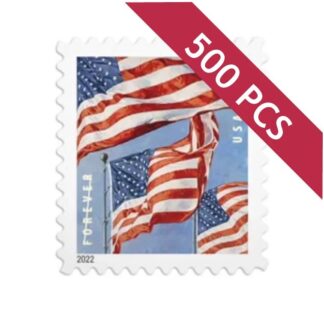
Count your pieces by weight class, multiply by the current First-Class rate, add a 2–3% buffer for spoilage and reprints, then convert the total into rolls or 100-piece packs. A business mailing 5,000 one-ounce letters a month needs 50 rolls of 100 Forever stamps — 52 rolls once the buffer is added — at a face value of $4,100.00, or $4,264.00 with the buffer.
Key Takeaways
- One Forever stamp covers a standard 1 oz letter at $0.82. Every additional ounce adds $0.29, so a 2 oz letter costs $1.11.
- Square, rigid, or unusually shaped envelopes need the $1.31 non-machinable stamp ($0.82 + the $0.49 surcharge), not a standard Forever stamp.
- Always add a 2–3% buffer: misprints, bad addresses, and torn envelopes are a normal part of any bulk mailing.
- Buy in the format your mailroom actually uses — coils of 100, 3,000, or 10,000 for machine-fed runs, books and sheets of 20 for hand affixing.
The 4-Step Formula: Pieces × Weight → Stamps → Cost
Every bulk stamp order starts with the same four steps. Run them once per mailing, not once per year, because the mix of letters, postcards, and heavy pieces changes with every campaign.
Step 1 — Sort the mailing by weight and shape. Weigh one finished sample of each piece type on a postal scale, including the insert and the envelope. A letter that looks like 1 oz is often 1.2 oz once the reply card goes in, and that pushes it into the 2 oz bracket.
Step 2 — Price each class. Use the table below, which follows the current USPS First-Class rates.
| Mailpiece | Postage per piece | Stamps per piece |
|---|---|---|
| Standard letter, 1 oz | $0.82 | 1 Forever stamp |
| Standard letter, 2 oz | $1.11 | 1 Forever + 1 additional-ounce stamp ($0.29) |
| Standard letter, 3 oz | $1.40 | 1 Forever + 2 additional-ounce stamps |
| Standard letter, 3.5 oz (maximum) | $1.69 | 1 Forever + 3 additional-ounce stamps |
| Postcard | $0.65 | 1 postcard stamp |
| Large envelope (flat), 1 oz | $1.69 | Postage to $1.69 |
| Square or non-machinable letter, 1 oz | $1.31 | 1 non-machinable stamp ($0.82 + $0.49 surcharge) |
| International letter, 1 oz | $1.75 | 1 Global Forever stamp |
Step 3 — Multiply and add the buffer. Pieces × stamps per piece gives the exact count. Then add 2–3%: on a 5,000-piece mailing, a 3% buffer is 150 stamps, roughly one and a half extra rolls.
Step 4 — Convert to packs. Divide the buffered total by the pack size and always round up. A half roll left over is not waste — Forever stamps never expire, so the remainder becomes next month’s opening stock.

Worked Example 1: 5,000 One-Ounce Letters a Month
Example — assumptions: a service company mails 5,000 standard 1 oz letters every month (statements and reminders), all at the current $0.82 Forever rate, with a 3% spoilage and reprint buffer.
| Line | Calculation | Result |
|---|---|---|
| Base pieces | 5,000 letters | 5,000 |
| Stamps at 1 per piece | 5,000 × 1 | 5,000 stamps |
| Face value, no buffer | 5,000 × $0.82 | $4,100.00 |
| Buffer at 3% | 5,000 × 0.03 | 150 stamps ($123.00) |
| Total to order | 5,150 stamps, rounded up | 52 rolls of 100 |
| Face value with buffer | 5,200 × $0.82 | $4,264.00 |
Two variations change the answer fast. If those same 5,000 letters weighed 2 oz instead of 1 oz, the postage becomes 5,000 × $1.11 = $5,550.00 — an extra $1,450.00 a month for one ounce. And if 500 of the 5,000 are square invitations, those 500 need the $1.31 non-machinable stamp: 500 × $1.31 = $655.00 instead of 500 × $0.82 = $410.00, a $245.00 difference on one batch.
That is why the weighing step matters more than the arithmetic. The math is easy; the expensive mistake is pricing a 2 oz mailing as a 1 oz mailing.
Worked Example 2: A Mixed Quarterly Mailing
Example — assumptions: a nonprofit mails quarterly: 10,000 standard 1 oz letters and 2,000 postcards, with a 3% buffer applied to the letters only (postcards are printed in exact runs).
| Piece type | Pieces | Rate | Cost |
|---|---|---|---|
| Standard letters, 1 oz | 10,000 | $0.82 | $8,200.00 |
| Buffer on letters, 3% | 300 stamps | $0.82 | $246.00 |
| Postcards | 2,000 | $0.65 | $1,300.00 |
| Quarter total | 12,300 stamps | — | $9,746.00 |
In rolls, that is 103 rolls of 100 Forever stamps plus 2,000 postcard stamps. Ordered as 100-piece packs, the letter stock is 103 packs. Put the buffer in the same order as the mailing it protects: a buffer that arrives two weeks after the mailing is just next quarter’s stock.
For larger buyers, the same math scales cleanly. At 10,000 letters a month, the annual face value is 120,000 × $0.82 = $98,400.00 before any buffer — which is exactly why a written quarterly count, not a guess, belongs in the procurement file.
Roll, Book, or Sheet: Picking the Right Format
The cheapest stamp is the one your mailroom can actually use without slowing down. Coils feed through affixing machines and high-volume runs; books and sheets suit hand mailing and small batches.
| Format | Count | Best for |
|---|---|---|
| Coil roll | 100 | Small mailrooms, weekly batches, first coil order |
| Coil roll | 3,000 | Machine-fed runs of a few thousand pieces |
| Coil roll | 10,000 | Continuous high-volume mailing, fewest changeovers |
| Book | 20 | Hand affixing, front-desk and branch use |
| Sheet / 100-piece pack | 20 per sheet, 5 sheets | Mixed use: sheets split across teams or locations |
As a procurement check, compare any bulk quote against the $0.82 face value per stamp before ordering. Our bulk and wholesale stamp category lists 100-piece packs at $69.00 against the $82.00 face value as of November 10, 2026, with the per-pack count stated on each product page — that is the kind of line-item comparison a buyer should be able to make in under a minute.

Setting a Reorder Point So You Never Run Dry
A standing order quantity is only half the system. The other half is the reorder point: the stock level that triggers the next order. The formula is weekly use × supplier lead time in weeks + buffer stock. A mailroom using 1,250 stamps a week with a two-week lead time and a 500-stamp buffer reorders at 1,250 × 2 + 500 = 3,000 stamps on hand.
December makes the reorder point matter more, not less. USPS recommends First-Class mail for Christmas delivery be sent by December 17, 2026, so holiday card and statement volume lands in the same two weeks as every other sender’s. Order the December stock in November, and treat the January lull as the time to recount — not the time to discover the count was wrong.
Five Mistakes That Inflate a Stamp Order
- Weighing the envelope empty. Inserts, reply cards, and thick paper push letters over 1 oz. Weigh the finished piece.
- Forgetting the square-envelope surcharge. A square invitation needs the $1.31 non-machinable stamp; a standard Forever stamp underpays it by $0.49.
- Ordering the exact count. Without a 2–3% buffer, one bad print run means a second order, second shipping wait, and a missed mail date.
- Mixing Global and domestic stock. International mail needs the $1.75 Global Forever stamp; a domestic Forever stamp does not cover it.
- Buying the wrong format. A 10,000-stamp coil saves changeovers but is the wrong buy for a team that hand-affixes 200 letters a week.
Frequently Asked Questions
How many Forever stamps do I need for 100 letters?
For 100 standard 1 oz letters, you need 100 Forever stamps, at a face value of $82.00. Add 2–3 extra stamps as a buffer, so order 102–103 stamps, or one roll of 100 plus a book of 20.
How many stamps do I need for a 2 oz letter?
One 2 oz letter costs $1.11: one Forever stamp ($0.82) plus one additional-ounce stamp ($0.29). Two Forever stamps also cover it, but you would overpay by $0.53 per letter.
How many stamps are in a roll?
Forever stamp coils come in rolls of 100, 3,000, and 10,000. A business mailing 5,000 letters a month uses 50 rolls of 100 before any buffer.
Do Forever stamps expire if I over-order?
No. A Forever stamp stays valid for a 1 oz First-Class letter even if the postage rate rises later, so buffer stock carries forward instead of expiring.
Sources
- USPS First-Class Mail & Postage — current 1 oz rate $0.82, non-machinable $1.31, postcard $0.65, large envelope $1.69.
- USPS Postal Store — official stamp formats, including coils of 100, 3,000, and 10,000.
- USPS Holiday Shipping Dates — recommended First-Class send-by date of December 17, 2026.
Run the count before you order, not after. If the math points to a standing monthly quantity, set it as a recurring order in our Forever stamps category and let the reorder point — weekly use times lead time, plus buffer — do the remembering for you.

Former USPS employee with 5 years of service and 25 years in corporate mailing management. Certified in Mail Systems Management and trained at the USPS Business Mail Academy, Kobe now shares trusted guidance on U.S. postage stamps and safe buying practices after retiring in 2023.