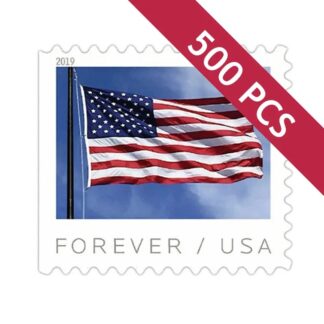
At 5,000 letters a month, Forever stamps cost $4,100 a month and metered mail costs $3,900 a month. The gap is $200 a month, or $2,400 a year, and it comes from the four-cent difference between the two rates: one Forever stamp covers a standard 1 oz First-Class letter at $0.82, while the same letter sent by metered mail is charged at the $0.78 metered-mail rate. The stamp is four cents dearer per piece, and the meter is not free. The right choice is the one that survives the whole cost, not just the postage line — so this guide runs the monthly math, prices the machine, and ends with the volume where each option wins.
Key Takeaways
- At 5,000 standard 1 oz letters a month, Forever stamps cost 5,000 x $0.82 = $4,100 a month, and metered mail costs 5,000 x $0.78 metered-mail rate = $3,900 a month. The postage gap is $200 a month and $2,400 a year.
- The gap is four cents a piece, so it scales exactly with volume: $20 a month at 500 pieces, $40 at 1,000, $100 at 2,500, $200 at 5,000, $400 at 10,000, and $1,000 at 25,000.
- A postage meter adds costs the stamp does not have: a lease or rental, maintenance, ink, and label rolls, plus a postal account that has to be funded in advance. If those costs run above $200 a month, the meter loses money at 5,000 pieces.
- Stamps need no equipment, no account, and no minimum volume. A meter needs a machine on the desk and a funded account behind it, and it only pays when the monthly volume is high enough to cover its fixed costs.
- The decision rule: below about 2,500 pieces a month, stamps win on total cost. At 5,000 pieces, the meter wins only if its fixed costs stay below $200 a month. At 10,000 pieces and above, the meter usually wins.
The Monthly Math at 5,000 Pieces
Both options mail the same letter: a standard 1 oz rectangular First-Class envelope. The only difference in the postage line is the rate, so the table below runs the same monthly counts through both rates and shows the gap at each volume. Read your row, and the postage answer is in front of you.
| Letters per month | Forever stamps at $0.82 | Metered mail at $0.78 metered-mail rate | Postage gap per month | Postage gap per year |
|---|---|---|---|---|
| 500 | $410.00 | $390.00 | $20 | $240 |
| 1,000 | $820.00 | $780.00 | $40 | $480 |
| 2,500 | $2,050.00 | $1,950.00 | $100 | $1,200 |
| 5,000 | $4,100.00 | $3,900.00 | $200 | $2,400 |
| 10,000 | $8,200.00 | $7,800.00 | $400 | $4,800 |
| 25,000 | $20,500.00 | $19,500.00 | $1,000 | $12,000 |
The gap is four cents a piece, so it grows in a straight line with volume — and it is the only saving the meter offers. A business mailing 5,000 letters a month saves $200 a month on postage by metering, and a business mailing 500 letters a month saves $20. That is the whole postage story. Everything else in the decision is a cost the meter adds and the stamp does not, and the next section prices those costs. For the same volume math applied to a single large campaign, see our 10,000-piece mailing calculator, and for the price of stamps at each order size, see our bulk price tiers guide.

What the Meter Costs That the Stamp Does Not
A postage meter is a machine, an account, and a supply chain, and all three cost money on top of the postage. The stamp is none of those things: a stamp is postage, bought once, with no machine behind it. The table below lists the meter costs a buyer should price before signing, and states plainly where no fixed price can be quoted — because the meter market prices by vendor, model, and contract, and any article that prints a single lease figure is inventing one.
| Meter cost | What it is | How to price it |
|---|---|---|
| Lease or rental | The monthly charge for the meter itself, set by the vendor and the model | Get a written quote for the model that matches your volume; compare it against the $200 monthly postage gap at 5,000 pieces |
| Maintenance and support | Service cover for the machine, sometimes bundled with the lease, sometimes billed separately | Ask whether it is included in the lease or charged on top, and what a call-out costs |
| Ink and label rolls | The consumables the meter prints with; a meter that cannot print cannot mail | Price a month of ink and labels at your volume, and add it to the monthly total |
| Postal account funding | Metered postage is paid from a funded account, so cash sits with the vendor before the mail goes out | Count the float: the account balance is money that is not in your bank |
| Staff time and training | Someone has to load, refill, and reconcile the meter, and learn the machine | Price the hours, not just the hardware; a machine that saves $200 in postage and costs four hours a month has saved nothing |
The break-even test is one line: add the lease, maintenance, ink, and labels for a month, and compare the total against the postage gap for your volume. At 5,000 pieces a month the gap is $200, so a meter whose fixed costs run above $200 a month loses money against stamps, and a meter whose fixed costs run below $200 a month saves money. At 500 pieces a month the gap is $20, so almost any meter loses money — the machine costs more than the saving it creates. At 25,000 pieces a month the gap is $1,000, so the meter has room to win even after its fixed costs. The postage rate is the same for every buyer; the fixed costs are what decide the answer, and they are different for every buyer, which is why the quote matters more than the rate.
What Stamps Do That a Meter Cannot, and the Reverse
Price is not the whole comparison. Stamps and meters behave differently in the office, and the difference matters most on the days the mailing is irregular. Stamps need no machine: a drawer of stamps mails from any desk, on any day, in any quantity, with no minimum and no account to fund. A volunteer can mail ten letters with ten stamps and no training. A meter needs the machine: the mail has to go through the desk where the meter sits, the account has to be funded before the mail goes out, and a machine that is out of ink or out of funds stops the mailing. On the other side, a meter prints the postage and the date in one pass, seals and counts as it goes, and gives a single monthly statement for the whole mailing — which is why a high-volume mailroom runs one. Stamps have to be applied one at a time, and a 5,000-piece run is a long afternoon of sticking stamps or a long run through a stamp applicator. The question is not which option is better in general. It is which option fits the way this office actually mails: steady and high volume favors the meter; irregular, small, or spread across desks favors the stamp.
The Decision Table: Which Option at Which Volume
Put the postage gap next to the fixed costs, and the decision writes itself. The table below assumes the $0.78 metered-mail rate against the $0.82 stamp, and a meter whose fixed costs are the buyer’s own quote — plug in your number and read the row.
| Monthly volume | Postage gap in favor of metered mail | Verdict |
|---|---|---|
| Under 1,000 pieces | $20 to $40 a month | Stamps. The gap is too small to cover any meter’s fixed costs. |
| 1,000 to 2,500 pieces | $40 to $100 a month | Stamps, unless the meter is already in place. A new meter rarely pays at this volume. |
| 5,000 pieces | $200 a month, $2,400 a year | Meter only if its fixed costs stay below $200 a month. Otherwise stamps. |
| 10,000 pieces | $400 a month, $4,800 a year | Meter usually wins. The gap is large enough to cover the machine and leave a saving. |
| 25,000 pieces and above | $1,000 a month, $12,000 a year | Meter. At this volume the postage saving dwarfs the fixed costs, and the machine’s counting and reporting are worth having on their own. |
Two cautions before deciding. First, keep the envelope rectangular and under 1 oz either way: a square envelope triggers the $0.49 non-machinable surcharge, so a square 1 oz letter mails at $1.31, not $0.82 with a stamp and not at the $0.78 metered-mail rate either. The surcharge applies to the piece, not to the payment method. Second, a Forever stamp bought today still mails a 1 oz letter after any future price increase, because Forever stamps never expire; a metered-mail rate is whatever the rate is on the day the mail goes out, so a meter locks in nothing. A business that buys stamps ahead is buying a rate lock as well as postage.
Ordering Stamps for a 5,000-Piece Month
If the decision is stamps, the order is simple arithmetic. A 5,000-piece month uses 5,000 stamps, which is $4,100.00 in postage, and a three-month supply is 15,000 stamps. We carry Forever stamps in bulk packs of 100, 500, and 1,000 pieces, in coils, booklets, and panes, so a 5,000-piece month is five 1,000-piece packs, or one coil of 3,000 plus two coils of 1,000, in the format the mailing desk actually uses. Order from the bulk and wholesale stamp packs while the drawer still holds a month of mail, not on the day it runs out. Forever stamps never expire, so stock bought this month is still good after any future price increase, and a drawer holding a month of the right quantity is the difference between mailing on schedule and mailing late. See the bulk Forever stamp packs and match the order to your monthly count.
The Verdict: Count the Gap, Then Price the Machine
At 5,000 letters a month, metered mail saves $200 a month in postage and Forever stamps cost $200 a month more — and that is the end of the postage comparison. The decision is made by the machine: if the lease, maintenance, ink, and labels run below $200 a month, the meter wins; if they run above it, the stamps win. Below 2,500 pieces a month, stamps win on total cost. At 10,000 pieces and above, the meter usually wins. Run your count through the table, get a written quote for the meter, and let the two numbers decide.
Frequently Asked Questions
How much does metered mail cost per piece in 2026?
A standard 1 oz First-Class letter sent by metered mail is charged at the $0.78 metered-mail rate. The same letter with a Forever stamp costs $0.82. The gap is four cents a piece, which is $200 a month at 5,000 letters and $2,400 a year.
Is metered mail cheaper than Forever stamps?
On postage alone, yes, by four cents a piece. But a postage meter adds a lease or rental, maintenance, ink, and label rolls, plus a funded postal account. At 5,000 letters a month, the meter only saves money if those fixed costs stay below the $200 monthly postage gap.
At what volume does a postage meter pay for itself?
It depends on the meter’s fixed costs, but the rule is simple: the monthly postage gap has to exceed the monthly fixed costs. The gap is $20 a month at 500 pieces, $100 at 2,500, $200 at 5,000, $400 at 10,000, and $1,000 at 25,000. Below about 2,500 pieces a month, stamps usually win on total cost.
Do I need a postage meter to mail 5,000 letters a month?
No. A 5,000-piece month needs 5,000 Forever stamps, which cost $4,100.00 in postage. Stamps need no machine, no account, and no minimum volume, and they can be applied by hand or through a stamp applicator. A meter is a convenience and a reporting tool at that volume, not a requirement.
Does the non-machinable surcharge apply to metered mail too?
Yes. A square envelope triggers the $0.49 non-machinable surcharge regardless of how the postage is paid, so a square 1 oz letter mails at $1.31, not $0.82 with a stamp and not at the $0.78 metered-mail rate. Keep envelopes rectangular and under 1 oz to avoid it.
Sources
- USPS Notice 123, Price List — current First-Class Mail rates: $0.82 for a 1 oz letter, $1.11 for 2 oz, $0.65 for a postcard, $0.29 per additional ounce, and the $0.49 non-machinable surcharge; metered-mail rates for First-Class Mail.
- USPS, First-Class Mail — 1 to 5 day service standard for First-Class Mail.

Former USPS employee with 5 years of service and 25 years in corporate mailing management. Certified in Mail Systems Management and trained at the USPS Business Mail Academy, Kobe now shares trusted guidance on U.S. postage stamps and safe buying practices after retiring in 2023.