A 10,000-piece mailing needs 10,000 Forever stamps if every piece is a standard 1 oz letter. At the current First-Class rate of $0.82, that is $8,200 in postage. The number changes the moment the format or the weight changes: the same 10,000 pieces as postcards need 10,000 postcard stamps at $0.65, or $6,500, and as 2 oz letters they need $11,100. Work the three numbers first — pieces, weight, format — and the order writes itself.
Key Takeaways
- Pieces × postage per piece = the stamp budget. 10,000 standard letters cost $8,200 at $0.82; 10,000 postcards cost $6,500 at $0.65.
- Weight is the hidden variable. A 2 oz letter costs $1.11, so a 10,000-piece mailing at 2 oz costs $11,100, not $8,200.
- 10,000 stamps is 100 coils of 100, or 3 coils of 3,000 plus 10 coils of 100, or a single coil of 10,000.
- Hold a 10 percent buffer, about 1,000 extra stamps on a 10,000-piece mailing, and reorder when stock falls to one mailing plus the buffer.
The Calculator: Pieces, Weight, Format
Three inputs decide the order: how many pieces, what each piece weighs, and what format it is. Read the table across for your volume and down for your format. Every figure below uses current USPS rates, and every figure assumes one stamp per piece at the stated rate.
| Pieces | Letter, 1 oz ($0.82) | Postcard ($0.65) | Large envelope, 1 oz ($1.69) |
|---|---|---|---|
| 1,000 | $820.00 | $650.00 | $1,690.00 |
| 5,000 | $4,100.00 | $3,250.00 | $8,450.00 |
| 10,000 | $8,200.00 | $6,500.00 | $16,900.00 |
| 25,000 | $20,500.00 | $16,250.00 | $42,250.00 |
The format decision is worth more than any discount hunt. Switching a 10,000-piece mailing from letters to postcards saves $1,700, and switching from large envelopes to letters saves $8,700. That is the whole calculation: pick the smallest format the message fits in, then multiply.

Weight Changes the Math
A letter that weighs 1 oz costs $0.82. Every additional ounce adds $0.29. That sounds small until it is multiplied by 10,000, when a single extra ounce costs $2,900. Weigh one finished piece before you order stamps. A two-page letter with a reply card is often 2 oz, and a letter with a brochure is often 3 oz, and both are easy to miss if nobody weighs anything.
| Letter weight | Postage each | 10,000 pieces | 25,000 pieces |
|---|---|---|---|
| 1 oz | $0.82 | $8,200.00 | $20,500.00 |
| 2 oz | $1.11 | $11,100.00 | $27,750.00 |
| 3 oz | $1.40 | $14,000.00 | $35,000.00 |
| 3.5 oz (letter maximum) | $1.69 | $16,900.00 | $42,250.00 |
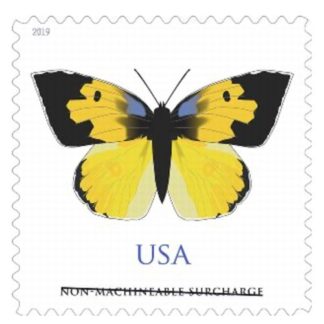
Two more weight traps. First, a square envelope triggers the $0.49 non-machinable surcharge, so a square 1 oz piece mails at $1.31, not $0.82. Keep mail rectangular and the table above stays true. Second, a large envelope starts at $1.69 for 1 oz, so a piece that could have been a letter costs more than twice as much for no reason. Check the current Notice 123 price list before you budget a heavier flat, because rates for heavier pieces are set per ounce and a budget built on last year’s price is wrong by the time the order ships.
Coils or Panes: Picking the Format
The stamp count is settled. The next question is how the stamps arrive: in coils of 100, 3,000, or 10,000, or in panes of 20. The face value is $0.82 per stamp in every format, so the choice is about handling, not price.
| Format | Stamps | Face value | Best for a 10,000-piece mailing |
|---|---|---|---|
| Coil of 100 | 100 | $82.00 | Daily batches; 100 coils cover the mailing |
| Coil of 3,000 | 3,000 | $2,460.00 | Quarterly stock; 3 coils plus 10 coils of 100 |
| Coil of 10,000 | 10,000 | $8,200.00 | One roll, one mailing room, deep stock |
| Pane / booklet of 20 | 20 | $16.40 | Small lots only; 500 panes for 10,000 pieces |
For most mailers, coils of 100 are the working size: easy to count, easy to hand to a second person, easy to verify. A coil of 10,000 suits a single mailing room that will use all 10,000 stamps itself. Panes of 20 are the wrong tool at this volume; counting 500 panes is a job nobody wants, and running out mid-batch is worse. We carry Forever stamps in bulk packs of 100, 500, and 1,000 pieces, so a 10,000-piece mailing is ten 1,000-piece packs. See the bulk and wholesale stamp packs and size the order to the table above, not to a guess.
Buffer Stock and Reorder Points
A mailing never uses exactly the number on the list. Pieces get damaged, addresses come back, and the list grows by a few dozen names after the stamps are ordered. Hold a buffer of about 10 percent, and set a reorder point so the next mailing never waits on a delivery.
| Monthly volume | Buffer (10%) | Reorder when stock falls to | Order size |
|---|---|---|---|
| 500 pieces | 50 stamps | 550 stamps | 500-piece pack |
| 1,000 pieces | 100 stamps | 1,100 stamps | 1,000-piece pack |
| 2,500 pieces | 250 stamps | 2,750 stamps | 2,500-piece pack |
| 10,000 pieces (one-off) | 1,000 stamps | n/a — order the full 11,000 | Ten 1,000-piece packs plus one more |
The rule is one sentence: when the drawer holds one mailing plus the buffer, place the next order. Forever stamps never expire, so the buffer is not money sitting idle; it is postage bought at today’s rate, still good after the next price increase. Store coils flat in a cool, dry drawer, out of direct sunlight, and keep one open coil at the mailing station with the rest sealed.
A Worked Example: 10,000 Pieces
Put it together. A company mails 10,000 two-page letters with a reply card. One finished piece weighs 2 oz, so postage is $1.11 each and the mailing costs $11,100. The stamp order is 10,000 stamps plus a 10 percent buffer of 1,000, or 11,000 stamps total. Bought as coils of 100, that is 110 coils. Bought in our 1,000-piece packs, that is eleven packs. If the same mailing could drop the reply card and stay at 1 oz, the cost falls to $8,200 plus the buffer, a saving of $2,900 on one mailing. That single decision, made before anything is printed, is worth more than any bulk discount.
Volume mailing rewards the buyer who does the arithmetic before the order, not after it. Count the pieces, weigh one finished envelope, pick the format, add the buffer, and order in bulk. See the bulk Forever stamp packs and match the order to your next mailing.
Frequently Asked Questions
How many Forever stamps do I need for a 10,000-piece mailing?
One stamp per standard 1 oz letter, so 10,000 stamps. At the current $0.82 rate that is $8,200. Add a 10 percent buffer, about 1,000 extra stamps, for damaged pieces, returns, and late additions to the list.
How much does it cost to mail 10,000 letters?
At the current rates, 10,000 standard 1 oz letters cost $8,200. The same 10,000 pieces as postcards cost $6,500, and as 2 oz letters they cost $11,100.
Should I buy coils of 100 or a coil of 10,000?
Coils of 100 suit most mailers: they are easy to count, split across people or locations, and verify. A coil of 10,000 suits one mailing room that will use all 10,000 stamps itself. The face value is $0.82 per stamp either way.
What if my mailpiece weighs more than 1 oz?
Each additional ounce adds $0.29. A 2 oz letter costs $1.11 and a 3 oz letter costs $1.40. Weigh one finished piece before ordering stamps, because an unweighed 2 oz mailing costs $2,900 more per 10,000 pieces than a 1 oz mailing.
Do Forever stamps expire if I buy 10,000 at once?
No. A Forever stamp is always good for one 1 oz First-Class letter, whatever the current rate is. Buying in bulk ahead of a price increase is a real saving, and a 10 percent buffer is postage, not waste.
Sources
- USPS Notice 123, Price List — current First-Class Mail rates: $0.82 for a 1 oz letter, $1.11 for 2 oz, $0.65 for a postcard, $1.69 for a 1 oz large envelope, $0.29 per additional ounce, and the $0.49 non-machinable surcharge.
- USPS, First-Class Mail — service standards and mailpiece rules.

Former USPS employee with 5 years of service and 25 years in corporate mailing management. Certified in Mail Systems Management and trained at the USPS Business Mail Academy, Kobe now shares trusted guidance on U.S. postage stamps and safe buying practices after retiring in 2023.