An online seller who ships 500 orders a month can put a thank-you card in every package for less than the cost of one returned order. The card itself is the cheap part. The decision that matters is where the card travels: inside the package, where it costs no postage at all, or in its own envelope, where it costs $0.82 with one Forever stamp. Most sellers should do both — a card in every box, and a mailed card for the customers worth a second touch. The math below covers both, so you can price the program before you print the first card.
Key Takeaways
- A thank-you card placed inside the outgoing package needs no stamp and no extra postage. It rides with the order you are already shipping.
- A thank-you card mailed separately in a standard 1 oz envelope costs $0.82 with one Forever stamp. A square card triggers the $0.49 non-machinable surcharge and mails at $1.31.
- A seller shipping 500 orders a month spends $410 a month on mailed cards at $0.82 each, or $4,920 a year. At 2,000 orders a month the cost is $1,640 a month.
- Keep the card rectangular, one page, and under 1 oz. A rigid or square card costs more to mail and slows down the packing line.
- Mail a follow-up card 2 to 3 weeks after delivery, not the day the order ships. First-Class Mail carries a 1 to 5 day service standard, so a card mailed on a Monday arrives that week.
Two Models: In the Box, or in Its Own Envelope
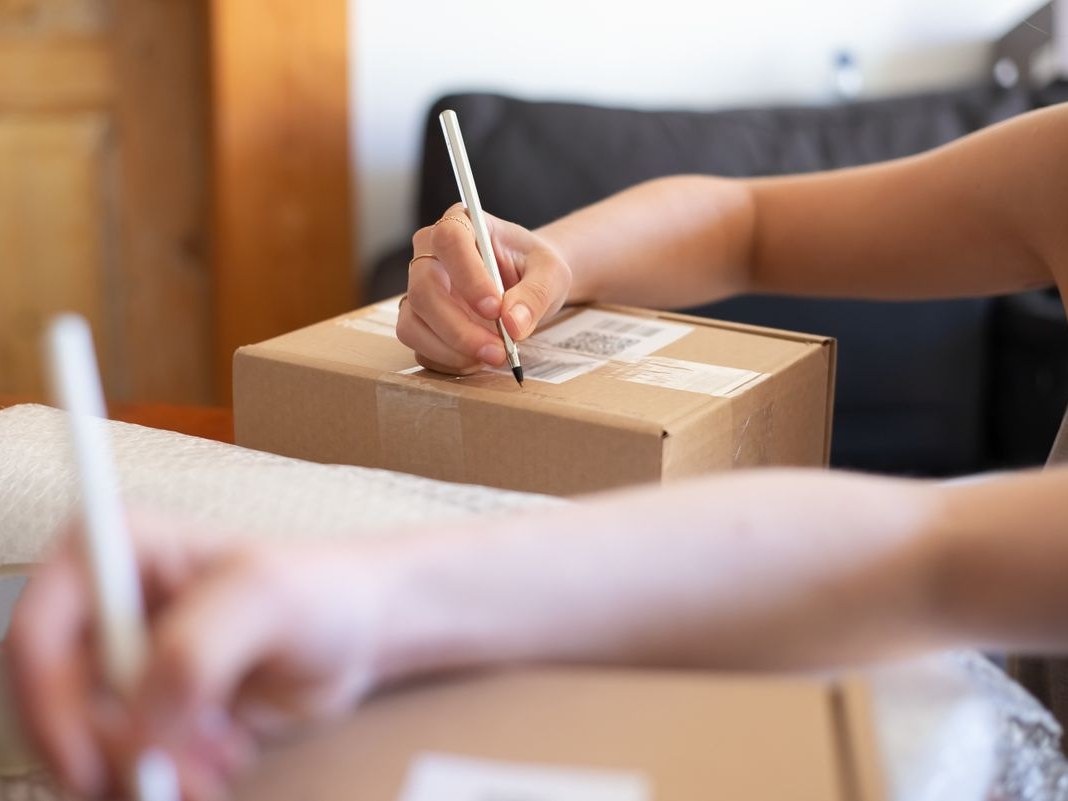
There are two ways to get a thank-you card to a customer, and they cost very different amounts. The in-package card is an insert: it goes into the box with the product, it is sealed with the order, and it travels on the postage you already paid for the parcel. The mailed card is a separate letter: it goes out in its own envelope, days or weeks after the order, and it needs its own stamp. A seller who only does the insert spends nothing on postage. A seller who only mails cards pays $0.82 per customer. The strongest programs do both, because the insert thanks the customer for the order and the mailed card brings them back for the next one.
| Model | Postage per card | When it arrives | Best for |
|---|---|---|---|
| Card inside the package | $0.00 — rides with the parcel | With the order | Every order, no exceptions; the baseline |
| Card mailed separately | $0.82 (1 oz letter) | 1 to 5 days after mailing | Repeat buyers, high-value orders, win-back |
| Postcard mailed separately | $0.65 | 1 to 5 days after mailing | Short thanks with a discount code, no enclosure |
| Square or rigid card, mailed | $1.31 ($0.82 + $0.49 surcharge) | 1 to 5 days after mailing | Avoid — redesign the card rectangular instead |
The square-card row is the trap. A square thank-you card looks good on the packing table and costs $0.49 extra on every single piece, because the non-machinable surcharge applies to square envelopes. On 2,000 mailed cards a month, that is $980 a month thrown away for a shape. Print the card rectangular, in a standard envelope, and the surcharge never applies. The $1.31 figure is the stamp value for a non-machinable letter — $0.82 plus the $0.49 surcharge — and it is the number to use whenever a square or rigid card is on the table.
What the Program Costs at Real Order Volumes
The mailed-card model is the one with a postage bill, so run it at your volume before committing. The table assumes a standard 1 oz rectangular letter at $0.82, and it assumes you mail a card to every customer. Most sellers mail to a subset — repeat buyers and orders above a threshold — so treat the full-volume number as the ceiling, not the budget.
| Orders per month | Mailed cards per month | Postage per month at $0.82 | Postage per year |
|---|---|---|---|
| 500 | 500 | $410.00 | $4,920.00 |
| 1,000 | 1,000 | $820.00 | $9,840.00 |
| 2,000 | 2,000 | $1,640.00 | $19,680.00 |
| 5,000 | 5,000 | $4,100.00 | $49,200.00 |
Cut the list before you cut the program. Mailing to every customer at 5,000 orders a month is $4,100 a month, but mailing only to repeat buyers and first orders above $50 is usually a third of the list, and it is the third that actually comes back. A seller who mails 1,000 cards a month to the right customers spends $820 and gets more repeat orders than a seller who mails 5,000 cards to everyone. For the same volume math applied to a different kind of bulk mailing, see our 10,000-piece mailing calculator. And for the retention-mailing mindset behind the whole program, our home services seasonal reminder guide shows how four letters a year keep a customer list warm.
The Packing SOP: A Card in Every Box Without Slowing the Line
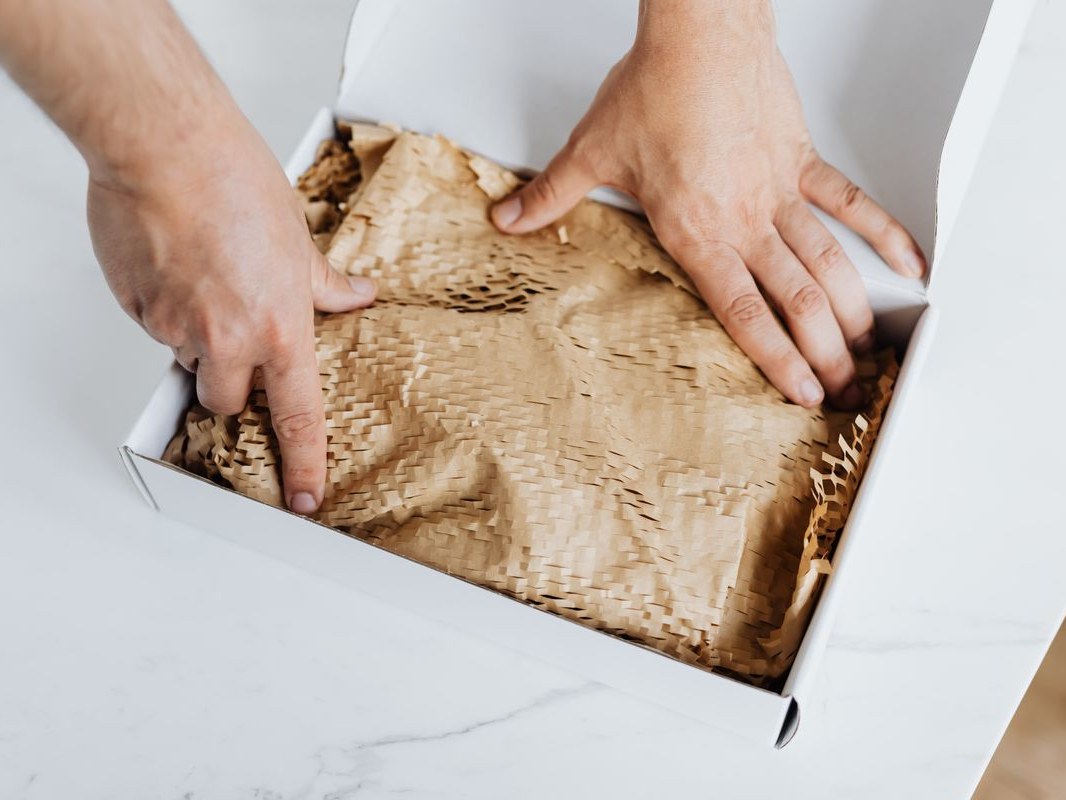
A thank-you card only works if it goes into every box, and it only goes into every box if the packing station makes it automatic. The SOP below adds about ten seconds a box.
- Put the cards at the packing station, not in a drawer. One stack of cards and one stack of envelopes, within arm’s reach of the sealer. A card that lives in another room does not go into the box.
- Pack the product, then place the card on top, face up. The card is the first thing the customer sees when the box opens. Never bury it under tissue paper or packing fill.
- Use one card design for every order. One design, one message, one stack. Seasonal variants are fine, but a different card for every product line means five stacks on the table and a card missed every time the packer reaches for the wrong one.
- Keep the card to one page and the envelope rectangular. A one-page card in a standard envelope weighs under 1 oz, so a mailed follow-up costs $0.82. A folded card with an insert can reach 2 oz, which costs $1.11. Weigh one finished card before ordering stamps.
- Batch the mailed cards once a week. Pull the week’s repeat buyers and high-value orders on Friday, address the envelopes in one sitting, affix one Forever stamp each, and carry the batch to the Post Office. A thousand pieces dropped in a street collection box can sit until the next pickup, so hand them over the counter.
- Track repeat orders, not cards sent. Count how many card recipients order again within 60 days, against customers who got no card. That count is the program’s return, and it is the number that decides whether the list grows or shrinks.
Ordering Stamps for a Card Program
The stamp order follows the mailed-card count, not the order count. A seller mailing 1,000 follow-up cards a month uses 12,000 stamps a year, which is $9,840 in postage at $0.82 a card. We carry Forever stamps in bulk packs of 100, 500, and 1,000 pieces, so a 1,000-card month is one 1,000-piece pack, and a year’s supply is twelve of them. Order from the bulk and wholesale stamp packs at the start of the month, before the first Friday batch, not after it. Forever stamps never expire, so stock bought this month is still good after any future price increase, and a drawer of stamps is the difference between mailing the follow-up cards on Friday and mailing them next Tuesday, after the moment has passed. Set a reorder rule while you are at it: when the stamp drawer holds less than one month’s worth of cards, place the next order. See the bulk Forever stamp packs and match the order to your monthly mailed-card count.
The Verdict: Card in Every Box, Stamp for the Ones Who Come Back
Put a card in every package. It costs no postage, it takes ten seconds, and it is the first thing the customer sees. Then mail a card to the customers worth a second touch — repeat buyers, high-value orders, and anyone who has not ordered in a while — at $0.82 each, in a rectangular envelope, in a Friday batch. That is the whole program: free where it is free, $0.82 where it counts, and a repeat-order count that tells you whether to grow it.
Frequently Asked Questions
How much does it cost to mail a thank-you card to a customer?
A standard 1 oz rectangular letter costs $0.82 with one Forever stamp. A postcard costs $0.65. A square or rigid card triggers the $0.49 non-machinable surcharge and mails at $1.31. A card placed inside the outgoing package costs no postage at all.
Does a thank-you card inside the package need a stamp?
No. A card placed inside the parcel rides on the postage you already paid for the package. The stamp is only needed when the card is mailed separately, in its own envelope, after the order ships.
How many stamps does an online seller need for 1,000 thank-you cards a month?
1,000 stamps a month, or 12,000 a year, which is $820 a month and $9,840 a year at $0.82 each. Most sellers mail to a subset — repeat buyers and high-value orders — so the real count is usually lower.
Should an e-commerce thank-you card be square or rectangular?
Rectangular. A square envelope triggers the $0.49 non-machinable surcharge, so a square card mails at $1.31 instead of $0.82. On 2,000 mailed cards a month, the square shape alone costs $980 a month.
When should an online seller mail a follow-up thank-you card?
Mail it 2 to 3 weeks after delivery, not the day the order ships. First-Class Mail carries a 1 to 5 day service standard, so a card mailed on a Monday arrives that week, after the customer has used the product and before they have forgotten the order.
Sources
- USPS Notice 123, Price List — current First-Class Mail rates: $0.82 for a 1 oz letter, $1.11 for 2 oz, $0.65 for a postcard, $0.29 per additional ounce, and the $0.49 non-machinable surcharge.
- USPS, First-Class Mail — 1 to 5 day service standard for First-Class Mail.

Former USPS employee with 5 years of service and 25 years in corporate mailing management. Certified in Mail Systems Management and trained at the USPS Business Mail Academy, Kobe now shares trusted guidance on U.S. postage stamps and safe buying practices after retiring in 2023.